Ranking #1 on Google Isn’t Enough: Why Conversion Optimization Matters More Than SEO Rankings in 2026
For years, businesses have treated Google’s first page as the ultimate destination.
Marketing agencies promise top rankings.
Business owners obsess over keywords.
Monthly SEO reports celebrate increased traffic.
But here’s the uncomfortable truth:
Ranking #1 on Google does not guarantee business growth.
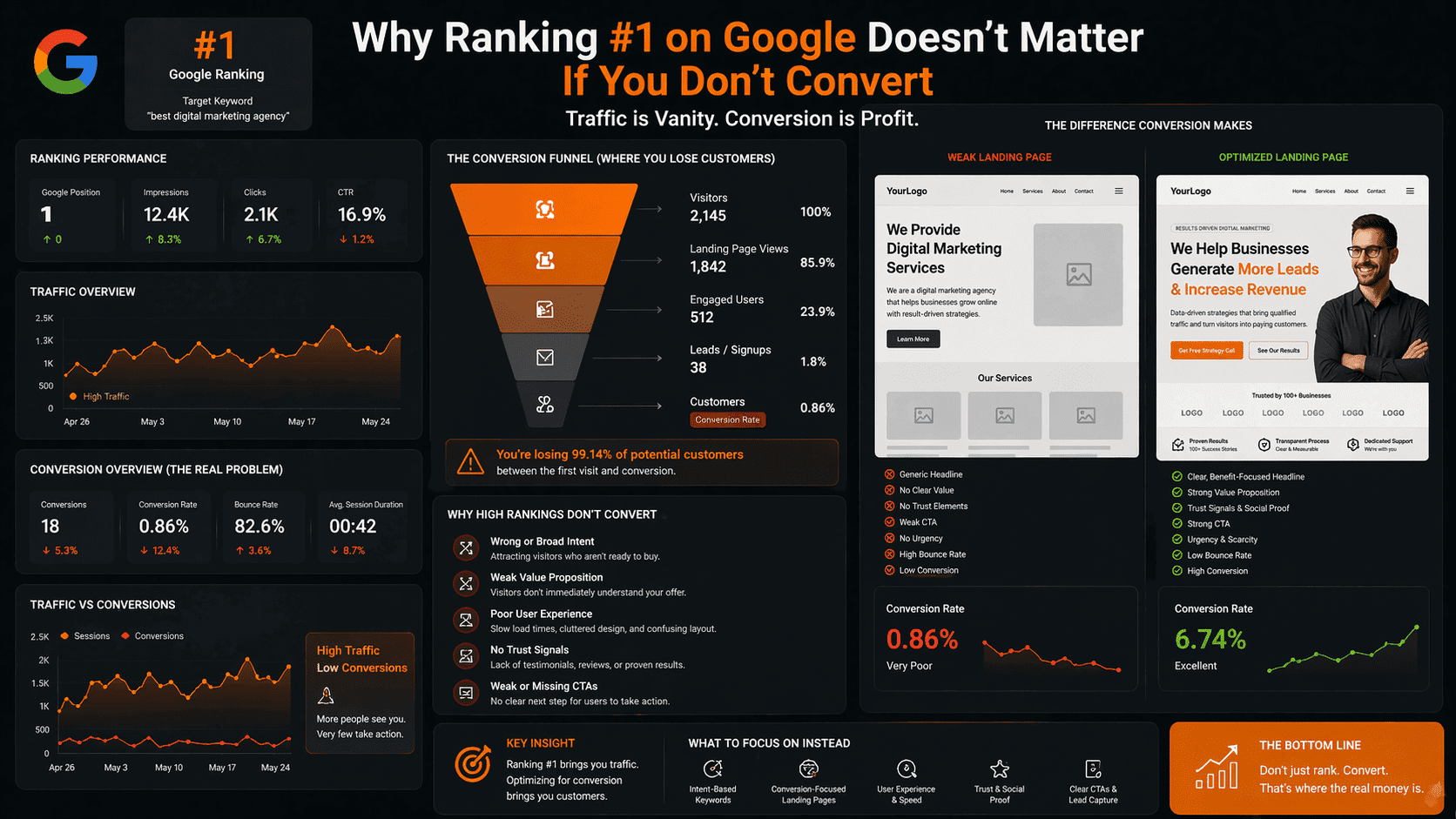
A website can receive thousands of visitors every month and still generate very few leads, sales, or enquiries.
Why?
Because rankings create visibility.
Conversions create revenue.
At Sterlingweb Growth Labs, we’ve audited websites that ranked at the top of Google yet failed to produce meaningful business results. We have also seen websites ranking below competitors generate significantly more revenue because they focused on customer experience, conversion optimization, and buying intent instead of traffic alone.
Modern SEO is no longer about getting visitors.
It’s about turning those visitors into customers.
Here’s why conversion optimization has become just as important as search engine rankings.
Traffic Is Potential—Conversions Create Profit
Every website owner loves seeing traffic increase.
More impressions.
More clicks.
More visitors.
It feels like progress.
But traffic is only the beginning of the customer journey.
If visitors arrive on your website and immediately leave without taking action, those rankings have produced little business value.
A website can rank #1 while still:
- Generating very few enquiries
- Producing poor sales
- Wasting advertising budgets
- Delivering low ROI
- Increasing bounce rates
Traffic is simply opportunity.
Revenue comes from what happens after someone lands on your website.
The Biggest SEO Mistake Businesses Still Make
Many SEO strategies focus entirely on improving keyword rankings.
They rarely consider what happens after someone clicks.
Businesses invest months creating content that ranks well but overlook critical questions like:
- Does the page answer the visitor’s questions?
- Is there a compelling reason to take action?
- Is the customer journey simple?
- Does the page build trust?
When these elements are missing, visitors leave without converting.
This creates a common problem:
High rankings.
High traffic.
High bounce rate.
Low revenue.
That’s not successful SEO.
That’s missed opportunity.
Ranking for the Wrong Keywords Attracts the Wrong Audience
Not every keyword represents buying intent.
For example, someone searching:
“What is Shopify?”
has very different intentions from someone searching:
“Hire Shopify development agency.”
One user is researching.
The other is ready to purchase.
Businesses often celebrate ranking for high-volume keywords while ignoring commercial search intent.
Instead of chasing traffic volume, focus on keywords that indicate customers are actively looking for solutions.
Examples include:
- Shopify development agency
- WordPress SEO services
- Website speed optimization company
- Technical SEO consultant
- WooCommerce to Shopify migration
- Core Web Vitals optimization
- AI SEO services
- AEO agency
- GEO optimization services
High-intent traffic consistently produces better business results than large amounts of untargeted visitors.
Your Landing Page Must Guide Visitors
SEO gets users onto your website.
Your landing page determines whether they stay.
Unfortunately, many landing pages are designed for search engines rather than people.
Common problems include:
- Generic headlines
- Weak value propositions
- Poor visual hierarchy
- No clear next step
- Confusing layouts
- Too much text without direction
A high-converting landing page should immediately answer four questions:
- What does this business do?
- Why should I trust them?
- How does this solve my problem?
- What should I do next?
If visitors cannot answer those questions within seconds, conversion rates will suffer regardless of rankings.
Strong Calls-to-Action Drive Decisions
One of the simplest improvements businesses can make is strengthening their Calls-to-Action (CTAs).
Many websites rely on vague buttons like:
- Learn More
- Submit
- Click Here
These provide little motivation.
Instead, use action-oriented CTAs such as:
- Book a Free Consultation
- Get a Custom Proposal
- Request a Shopify Audit
- Schedule Your SEO Strategy Call
- Start Your Website Project
A clear CTA removes uncertainty and encourages users to take the next step.
Trust Is the Biggest Conversion Factor
Even interested visitors hesitate if they don’t trust your business.
Trust isn’t created through design alone.
It comes from proof.
Effective trust signals include:
- Client testimonials
- Case studies
- Verified reviews
- Portfolio examples
- Industry certifications
- Awards
- Security badges
- Transparent pricing
- Real team information
People don’t simply buy products or services.
They buy confidence.
The more evidence you provide that your business delivers results, the easier it becomes for customers to choose you.
User Experience Directly Affects Revenue
Google increasingly rewards websites that deliver excellent user experiences.
Customers expect websites to be:
- Fast
- Mobile-friendly
- Easy to navigate
- Visually organized
- Accessible
- Secure
If your website loads slowly, feels confusing, or performs poorly on smartphones, users leave before converting.
A professional website should provide:
- Fast page loading
- Clean navigation
- Simple forms
- Mobile-first layouts
- Logical content flow
- Accessible design
User experience influences both SEO rankings and conversion rates simultaneously.
Website Speed Impacts Both Rankings and Sales
Performance isn’t only an SEO metric.
It directly affects customer behavior.
Slow websites increase:
- Bounce rates
- Cart abandonment
- Customer frustration
- Advertising costs
Professional optimization focuses on:
- Core Web Vitals
- Image compression
- Efficient code
- Caching
- Content Delivery Networks (CDNs)
- JavaScript optimization
A faster website improves rankings while also increasing customer satisfaction and conversions.
Every Website Needs a Conversion Funnel
Many websites stop thinking after someone visits.
Successful businesses think beyond the first click.
A complete conversion funnel includes:
- Valuable landing pages
- Lead capture forms
- Email follow-up sequences
- Consultation booking
- CRM integration
- Marketing automation
- Retargeting campaigns
Visitors rarely purchase immediately.
Your website should continue nurturing relationships long after the initial visit.
Without a structured funnel, valuable traffic disappears.
Modern SEO Combines Visibility and Conversion
Today’s highest-performing websites combine:
- Technical SEO
- High-intent keyword research
- Helpful content
- Conversion Rate Optimization (CRO)
- Mobile-first design
- Core Web Vitals
- Strong calls-to-action
- Trust-building elements
- Analytics
- Marketing automation
SEO and CRO should never operate independently.
They work together to create measurable business growth.
AI Search Makes Conversion Even More Important
As platforms like ChatGPT, Gemini, Claude, Copilot, and Perplexity influence buying decisions, attracting visitors is becoming only one part of digital marketing.
Businesses must optimize for:
- Traditional SEO
- Answer Engine Optimization (AEO)
- Generative Engine Optimization (GEO)
- AI-ready content
- Structured data
- Entity optimization
However, even if AI search sends qualified visitors to your website, poor conversion experiences will still limit results.
Future-ready businesses optimize both discovery and conversion.
Why Businesses Choose Sterlingweb Growth Labs
At Sterlingweb Growth Labs, we believe rankings are only valuable when they generate measurable business outcomes.
Our growth strategy combines:
- Technical SEO
- Conversion Rate Optimization (CRO)
- Answer Engine Optimization (AEO)
- Generative Engine Optimization (GEO)
- WordPress Development
- Shopify Development
- Website Speed Optimization
- Core Web Vitals Improvements
- UX Strategy
- Lead Generation Systems
- Marketing Automation
Instead of chasing rankings alone, we help businesses build digital systems that consistently convert visitors into customers.
Final Thoughts
Ranking #1 on Google is an achievement—but it should never be the ultimate goal.
Visibility without conversion creates impressive analytics but disappointing business results.
The businesses that outperform competitors understand that SEO is only the first stage of customer acquisition.
Real growth happens when visitors trust your brand, understand your value, and feel confident enough to take action.
Instead of asking:
“How can I rank higher?”
Ask:
“How can I convert more of the traffic I already have?”
That shift in thinking often produces far greater returns than chasing additional rankings alone.
At Sterlingweb Growth Labs, we help businesses combine SEO, AEO, GEO, and Conversion Rate Optimization into one unified growth strategy—because traffic should never be the final objective.
Revenue is.
Frequently Asked Questions
Is ranking #1 on Google enough to grow a business?
No. High rankings increase visibility, but without strong landing pages, trust signals, and conversion optimization, traffic may not generate leads or sales.
What is Conversion Rate Optimization (CRO)?
CRO is the process of improving your website so more visitors complete valuable actions such as making a purchase, filling out a form, or booking a consultation.
Which is more important: SEO or CRO?
Both are essential. SEO brings qualified visitors to your website, while CRO turns those visitors into customers. They work best when implemented together.
Why do some websites rank well but generate few leads?
Common reasons include poor user experience, weak calls-to-action, slow loading speeds, low trust, and targeting keywords with low buying intent.
How can businesses improve conversions?
Focus on high-intent keywords, fast page speed, mobile-first design, compelling headlines, clear CTAs, trust-building content, streamlined forms, and ongoing performance analysis to continuously improve results.