

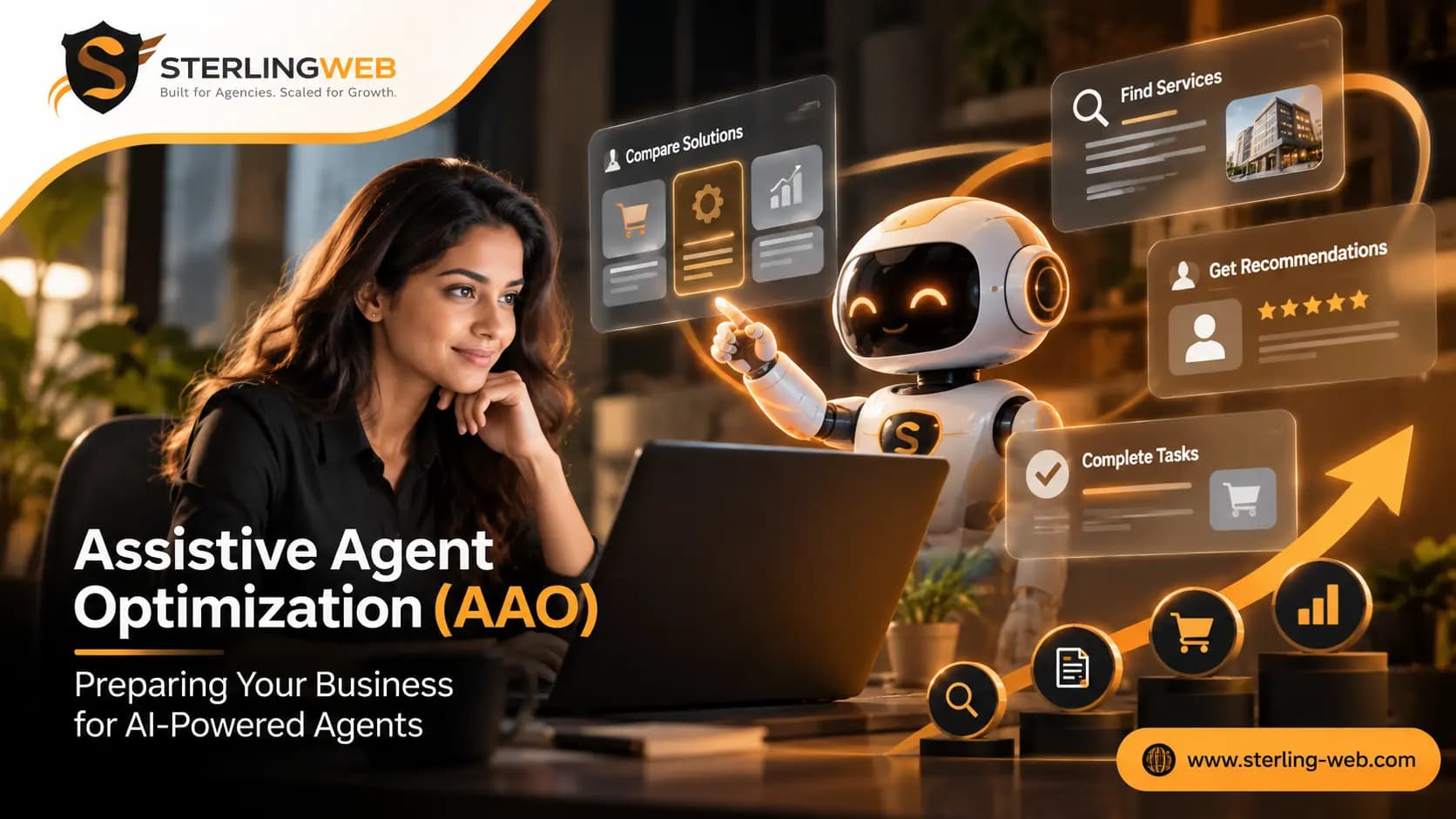
AI is changing how customers research businesses, compare solutions, and make purchasing decisions. Instead of opening multiple websites and evaluating every option themselves, people can increasingly use AI assistants to summarize information, compare products, identify service providers, and help complete specific tasks.
This creates a new challenge for businesses: Will AI-powered systems be able to find your information, understand what you offer, and determine whether your business fits a user’s requirements?
Traditional search engine optimization (SEO) remains an important foundation. However, as AI systems develop more advanced research and action-taking capabilities, businesses may also need to consider how their websites, product information, integrations, and digital workflows support these experiences.
This emerging approach is known as Assistive Agent Optimization (AAO). It extends the conversation beyond appearing in search results or AI-generated answers to consider how businesses can become understandable, relevant options for AI systems assisting users.
AAO is not yet a universally standardized technical discipline. Its practical meaning depends on the framework being used and the capabilities of the AI systems involved. For businesses, the priority should be to understand the real requirements behind the concept rather than chase another acronym.
Quick Answer: What Is Assistive Agent Optimization (AAO)?
Assistive Agent Optimization (AAO) is an emerging approach to improving how a business’s digital information and supported services can be discovered, understood, evaluated, and, where technically possible, used by AI-powered agents.
Depending on the business, this can involve technical SEO, accessible website content, structured data, consistent business information, product and service documentation, supported integrations, and reliable digital workflows.
The objective is to make a business easier for relevant AI systems to understand and evaluate, while ensuring that any interactions are secure and technically supported.
AAO does not guarantee that an AI agent will recommend a business, select its products, or complete a transaction. Those outcomes depend on the particular system, its data sources, its capabilities, user requirements, and other factors outside a website owner’s control.
Key Findings
- SEO remains foundational: Crawlability, indexing, helpful content, and a technically sound website continue to support search visibility.
- AI discovery and agent actions are different: A system that can summarize a webpage may not be able to interact with the website or complete a transaction.
- Clear information improves understanding: Accurate service descriptions, product details, pricing information, and documentation help people and systems evaluate a business.
- Integrations matter when actions are involved: APIs, permissions, authentication, and reliable workflows may be relevant when an agent needs to do more than retrieve information.
- Measurement must reflect business objectives: AI-related referrals, relevant brand mentions, qualified enquiries, and successful task completion can provide useful evidence.
- AAO terminology is still evolving: Businesses should prioritize verified technical requirements and useful outcomes over unproven optimization techniques.
Why Does Assistive Agent Optimization Matter?
Consider a business owner looking for a development partner to migrate an ecommerce store, integrate third-party applications, and improve website performance.
An AI assistant may help compare providers using available information about their services, technologies, experience, and project suitability. Some systems may also use tools or supported workflows to help users take the next step.
If a company’s website provides only vague descriptions of its capabilities, it may be difficult for a prospective customer to determine whether it meets those requirements.
A more informative website can clearly explain the company’s services, supported technologies, project scope, and relevant experience. This helps potential customers evaluate the business and gives information-retrieval systems more useful material to work with.
Three developments make this worth considering.
1. Customers can research without visiting every website
AI-powered search experiences can summarize information and provide links to relevant sources. Users may form an initial opinion about a business before visiting its website.
This makes the accuracy, clarity, and usefulness of publicly available business information important.
2. Some AI systems can use tools to perform tasks
Depending on the platform, AI systems may be able to navigate supported interfaces, retrieve information from connected applications, or initiate permitted workflows.
For example, an agent might search a product catalog or use a documented integration to retrieve information. Whether it can complete a purchase, submit an enquiry, or make a booking depends on the specific system and its permissions.
3. Digital readiness involves more than content
A business may publish excellent information but still have technical barriers, broken forms, inaccessible interface elements, or unreliable integrations.
When an AI agent needs to interact with a website, those operational issues may become just as important as whether it can discover the relevant page.
The key takeaway is not that traditional SEO is becoming irrelevant. It is that businesses should understand the full journey from discovery to evaluation and, where supported, action.
AAO vs SEO vs AEO vs GEO: What Is the Difference?
These terms describe related areas of digital visibility, but their definitions vary across practitioners. The following comparison is a practical framework rather than an official industry standard.
| Approach | Main emphasis | Business objective |
|---|---|---|
| Search Engine Optimization (SEO) | Search accessibility, indexing, relevance, and organic visibility | Help relevant users discover website content |
| Answer Engine Optimization (AEO) | Clear, useful answers to specific questions | Make information easier to retrieve and present as an answer |
| Generative Engine Optimization (GEO) | Content and brand visibility in generative AI experiences | Improve opportunities for relevant information to be represented in AI-generated responses |
| Assistive Agent Optimization (AAO) | Discovery, evaluation, and supported interaction with AI agents | Prepare a business’s digital presence for AI-assisted decision-making and task execution |
AAO can be understood as a broader operational perspective that builds on many of the foundations used in SEO, AEO, and GEO.
For example, a SaaS company may use SEO to attract relevant organic traffic, AEO to answer common product questions, and GEO practices to improve how its expertise is represented in generative AI experiences.
An AAO-related initiative may additionally examine whether product documentation is accessible, integration details are accurate, APIs are documented, and supported workflows allow authorized systems to retrieve information or perform particular actions.
These approaches can complement one another. They should not be treated as completely separate systems, nor should businesses assume that every website needs a dedicated AAO implementation.
Google’s official guidance confirms that established SEO best practices remain relevant to AI features in Google Search. It does not require a separate set of special optimizations for inclusion in AI Overviews or AI Mode.
Reference: Google Search Central — Optimizing your website for generative AI features.
How Can AI Agents Discover and Use Business Information?
There is no single technical process shared by every AI assistant or agent. The appropriate preparation depends on how the target system retrieves information and what it is capable of doing.
Website discovery and retrieval
Some AI experiences use web search, indexes, or retrieval systems to find relevant information.
A business should make important pages accessible to the search systems it wants to support. Relevant considerations include crawl permissions, indexability, internal linking, server responses, and whether essential content is available in a form that can be retrieved.
OpenAI, for example, documents OAI-SearchBot as a crawler used to surface websites in ChatGPT search features. It distinguishes this from GPTBot, which serves a different purpose. Website owners can review the relevant crawler rules and make informed decisions about access.
Reference: OpenAI — Overview of OpenAI crawlers.
Content interpretation
Once information is available, systems may need to interpret the business’s services, products, policies, or technical capabilities.
Clear page titles, descriptive headings, specific service descriptions, and accurate supporting information help readers understand what a business actually offers.
For example, a development company should distinguish Shopify store development, custom theme development, migration services, and third-party integrations rather than presenting everything as a generic web development service.
Evaluation and suitability
When a user asks for a recommendation, an AI system may consider information relevant to the request. Depending on the task, this might include supported features, location, price, compatibility, availability, or evidence of relevant expertise.
The selection process varies between systems and is not fully transparent.
Businesses should therefore provide accurate, specific information about their capabilities and limitations instead of relying on broad claims such as “the number-one provider for every business.”
Supported interaction and task execution
Some agents can use tools, APIs, or browser interfaces to retrieve information or carry out actions. Others can only answer questions or direct users to websites.
When action-taking is relevant, businesses may need to assess interface accessibility, API documentation, authentication, permission controls, and workflow reliability.
This is where AAO-related planning can extend beyond conventional content optimization. However, additional integrations should be implemented only when there is a genuine business use case and the relevant AI system supports them.
Six Practical Areas to Review in an AAO Strategy
A useful AAO initiative should focus on identifiable requirements rather than speculative ranking tricks.
1. Technical SEO and crawler access
Review the technical conditions that allow relevant systems to access the website.
Important checks include:
- Robots.txt directives and crawler permissions.
- Noindex directives and canonical URLs.
- HTTP status codes, redirects, and broken pages.
- XML sitemaps and internal link discovery.
- JavaScript rendering and essential page content.
- CDN, firewall, and bot-protection behavior.
- Mobile usability and website performance.
Crawler access should be evaluated by platform and purpose. A business may choose to permit a search crawler while applying different rules to a crawler used for model training.
Technical accessibility makes information available to supported systems, but it does not guarantee that they will select or recommend it.
2. Structured data and accurate information
Structured data provides machine-readable information about a page. Depending on the content, appropriate types may describe an organization, product, article, or other supported entity.
For example, ecommerce businesses should ensure that relevant product information, including prices and availability where applicable, is accurate and consistent with the visible page.
Structured data should be implemented according to the requirements of the platforms that use it. It should not be treated as a special signal that forces an AI system to recommend a business.
Google’s documentation explains its structured data requirements and the importance of accurately representing visible content.
Reference: Google Search Central — Structured data policies.
3. Clear product, service, and company information
A business website should answer the questions that customers genuinely need resolved.
For a service provider, this could include:
- What services are available?
- Which industries or business types are supported?
- What technologies and integrations are offered?
- What does the engagement include?
- Which requirements affect cost or delivery?
- What limitations should customers understand?
- How can a prospective customer request further information?
For SaaS companies, product documentation, pricing, feature comparisons, supported integrations, and security information may be particularly useful.
For ecommerce brands, accurate product specifications, variants, stock information, shipping details, and return policies can help customers make informed decisions.
The aim is not to rewrite every page into a rigid AI-friendly template. It is to make important information accurate, accessible, and understandable.
4. Consistent brand information and credible evidence
Business details can become inconsistent across websites, profiles, directories, and other public sources.
Review important facts such as the company name, official website, contact details, services, product descriptions, pricing, and policies. Update outdated information and make sure claims about expertise can be substantiated.
For agencies and consultants, relevant case studies, clearly described experience, and verifiable credentials may help prospective customers assess suitability.
Do not manufacture reviews, citations, or brand mentions to create an artificial appearance of authority. Consistency and evidence are more defensible than volume alone.
5. Accessible interfaces and supported integrations
When an AI system is expected to interact with a website, content alone may not be enough.
Review whether important workflows have:
- Clearly labelled links, buttons, and form fields.
- Understandable validation and error messages.
- Reliable navigation and predictable page states.
- Accessible product, booking, or enquiry flows.
- Documented APIs or supported tool integrations where appropriate.
- Appropriate authentication, authorization, and privacy safeguards.
Not every business needs custom agent integrations. For many websites, resolving ordinary usability and technical problems is a more useful first step.
6. Reliable and secure task completion
A workflow that works for a human may still behave differently when accessed through an automated system. Testing should reflect the actual interaction method and permissions supported by the relevant platform.
For example, a business that supports automated product lookup should test whether the correct product information is returned and whether unavailable items are handled properly.
Any workflow involving purchases, bookings, account changes, or sensitive information should retain appropriate safeguards. An agent should not be granted broader access than the task requires.
AAO Use Cases Across Different Industries
SaaS businesses
Software buyers often compare product features, pricing, integrations, compatibility, and security before choosing a platform.
An AAO-related assessment may review whether documentation is accessible, product features are described accurately, integration requirements are clear, and API capabilities are documented.
For example, a project management platform could explain its supported integrations, user permissions, plan limitations, and API documentation. This helps prospective customers understand whether the software fits their needs.
Ecommerce brands
Retailers depend on accurate product data and a reliable purchasing experience.
Relevant work may include improving product descriptions, keeping stock information current, validating structured data, maintaining catalog navigation, and reviewing supported product feeds or integrations.
Where an AI shopping system supports product discovery or purchasing workflows, retailers should check its actual eligibility and technical requirements rather than assume every platform works the same way.
Professional service providers
Development agencies, marketing consultancies, and other service businesses need to communicate their capabilities clearly.
Useful information includes the scope of services, supported technologies, target industries, engagement models, project requirements, and relevant experience.
For instance, a Shopify development agency can explain the difference between store setup, custom theme development, migration, Shopify Plus projects, and ongoing maintenance.
This gives prospective customers a more useful basis for evaluating the provider.
Local businesses
Local discovery can depend on accurate information about location, services, opening hours, availability, and contact details.
Businesses should maintain their official website and relevant business profiles, keep service information current, and explain the areas or customer needs they support.
An AI assistant may rely on different sources depending on the platform, so no single profile or optimization method should be assumed to control all local recommendations.
How to Measure AAO Performance
AAO is an emerging term rather than a standardized measurement framework. Businesses should therefore define what success means for their particular use case before investing in additional work.
AI-related visibility
Create a consistent set of relevant customer questions and monitor how the business appears across selected AI experiences.
Record whether the brand appears, which pages or sources are referenced, whether the description is accurate, and how the results compare over time.
Responses can vary by platform, location, question wording, and date. A few observations should not be presented as universal rankings.
Referral traffic and engagement
Use available analytics to monitor identifiable visits from AI-related sources.
Relevant indicators may include referral sessions, landing pages, engagement, enquiry submissions, and conversions where reliable attribution is available.
Not every AI interaction produces a website visit, and analytics may not identify every AI-assisted journey. Referral traffic is useful, but it is not a complete measure of visibility.
Brand accuracy and qualified enquiries
Review whether the business is represented accurately in relevant AI answers and public information sources.
Track incorrect descriptions, outdated information, missing service details, and other issues that can be corrected at their source.
For lead generation, monitor the quality of enquiries, including whether they match the business’s intended services, markets, and project requirements. Combine analytics with customer feedback where practical.
Successful task completion
For businesses that actually support agent-assisted workflows, measure whether the intended task can be completed correctly and securely.
Possible indicators include successful product lookups, valid enquiry submissions, successful authorized bookings, error rates, and abandoned workflows.
These measures should be used only where the business has a real, testable agent interaction or integration.
Common AAO Mistakes Businesses Should Avoid
Assuming a special file guarantees AI visibility
Files such as llms.txt may be used in particular workflows, but they are not a universal requirement for appearing in AI search. Google’s published guidance does not identify llms.txt as a ranking or AI visibility requirement.
Prioritize documented platform requirements and measurable business needs.
Treating structured data as a shortcut
Structured data can help describe page content and support certain search features. It cannot force an AI system to select a brand or guarantee a recommendation.
Publishing generic content at scale
Producing large volumes of repetitive articles about AI visibility may create little additional value for readers.
Focus on original insights, useful examples, clear explanations, and content that answers genuine questions. Where possible, add evidence from real work rather than repeating general claims.
Ignoring technical problems
Additional content will not fix blocked pages, broken forms, incorrect canonical tags, or inaccessible product information.
Review technical foundations before expanding a content campaign or investing in specialized integrations.
Expecting guaranteed AI recommendations
AI systems use different sources, retrieval methods, tools, permissions, and selection processes. No provider can credibly guarantee that every platform will recommend a particular business.
A responsible strategy focuses on what can be improved and measured, while being clear about the limits of control.
How SterlingWeb Can Help With AI Search Readiness
Businesses exploring AAO may need a combination of established SEO work and carefully selected improvements for AI-assisted discovery or workflows.
SterlingWeb provides services across technical SEO, Answer Engine Optimization (AEO), Generative Engine Optimization (GEO), and website development. Depending on a project’s needs, these capabilities can help improve the technical quality, clarity, accessibility, and usefulness of a business’s digital presence.
Relevant work may include:
- Technical SEO reviews covering crawlability, indexing, rendering, and website performance.
- Content and information architecture improvements.
- Structured data implementation and validation where appropriate.
- AEO and GEO content strategies focused on clear answers and verifiable expertise.
- WordPress, Shopify, WooCommerce, and custom website development.
- Reviews of supported integrations and website workflows where an agent-related use case exists.
AAO-specific work should begin by identifying the relevant AI systems, the intended business outcome, and whether the project involves information discovery, recommendation, or actual task execution.
Not every business needs a separate AAO service or a custom AI integration. The right approach depends on its existing digital foundations and its customers’ needs.
Explore SterlingWeb’s Technical SEO, AEO, and GEO Services or learn more about our SEO services in India.
Frequently Asked Questions About Assistive Agent Optimization
What are Assistive Agent Optimization (AAO) Services?
Assistive Agent Optimization Services refer to work intended to improve how a business’s digital information and supported services can be discovered, understood, evaluated, and, where technically possible, used by AI agents. The exact scope varies because AAO is an emerging practitioner term rather than a universally standardized service category.
Is AAO different from traditional SEO?
AAO places additional emphasis on AI systems that may evaluate options or perform permitted actions for users. Traditional SEO focuses on search visibility, crawling, indexing, and relevant organic discovery. Many AAO-related activities still depend on strong SEO foundations.
Does every business need AAO services?
No. Many businesses should begin by improving their existing technical SEO, content quality, business information, and website usability. A more specialized AAO initiative may be worthwhile when there is a clear use case involving AI-assisted product discovery, supported integrations, or agent-driven workflows.
Does structured data help AI agents understand a website?
Structured data provides machine-readable information about page content and can support eligible search features. Its usefulness depends on the system and implementation. It must accurately reflect visible content and does not guarantee AI citations or recommendations.
How long does AAO take to produce results?
There is no universal timeline. Technical fixes can be completed relatively quickly, while changes in crawling, indexing, visibility, referral traffic, or qualified leads may take longer. Outcomes depend on the website, the platforms involved, and factors outside the business’s control.
Can AAO guarantee that AI agents will recommend a business?
No. AI systems use different information sources, tools, capabilities, and selection processes. A responsible approach improves the quality and accessibility of a business’s information and measures observable outcomes without promising guaranteed recommendations.
Conclusion: Prepare Your Business for AI-Assisted Discovery
Assistive Agent Optimization reflects an important question for businesses: how can digital information remain useful as customers increasingly rely on AI systems to research, compare, and sometimes act on their behalf?
The answer begins with a strong foundation: technically accessible websites, accurate business information, useful content, appropriate structured data, and reliable user experiences.
Where a genuine use case exists, businesses can also assess supported integrations, agent-accessible workflows, permissions, and task reliability. These improvements should be guided by actual platform capabilities rather than assumptions about a universal AI ranking formula.
For businesses evaluating their next steps, the priority is to identify what customers need, understand how relevant AI systems access information, and invest in improvements that can be tested and measured.
SterlingWeb helps businesses strengthen their technical SEO, AEO, GEO, and website foundations for evolving search experiences. If your business is exploring AI search visibility or preparing its digital presence for AI-assisted workflows, contact SterlingWeb to discuss your requirements.
The goal is not to chase another acronym. It is to build a digital presence that is accurate, accessible, useful, and ready for the ways customers discover and evaluate businesses.