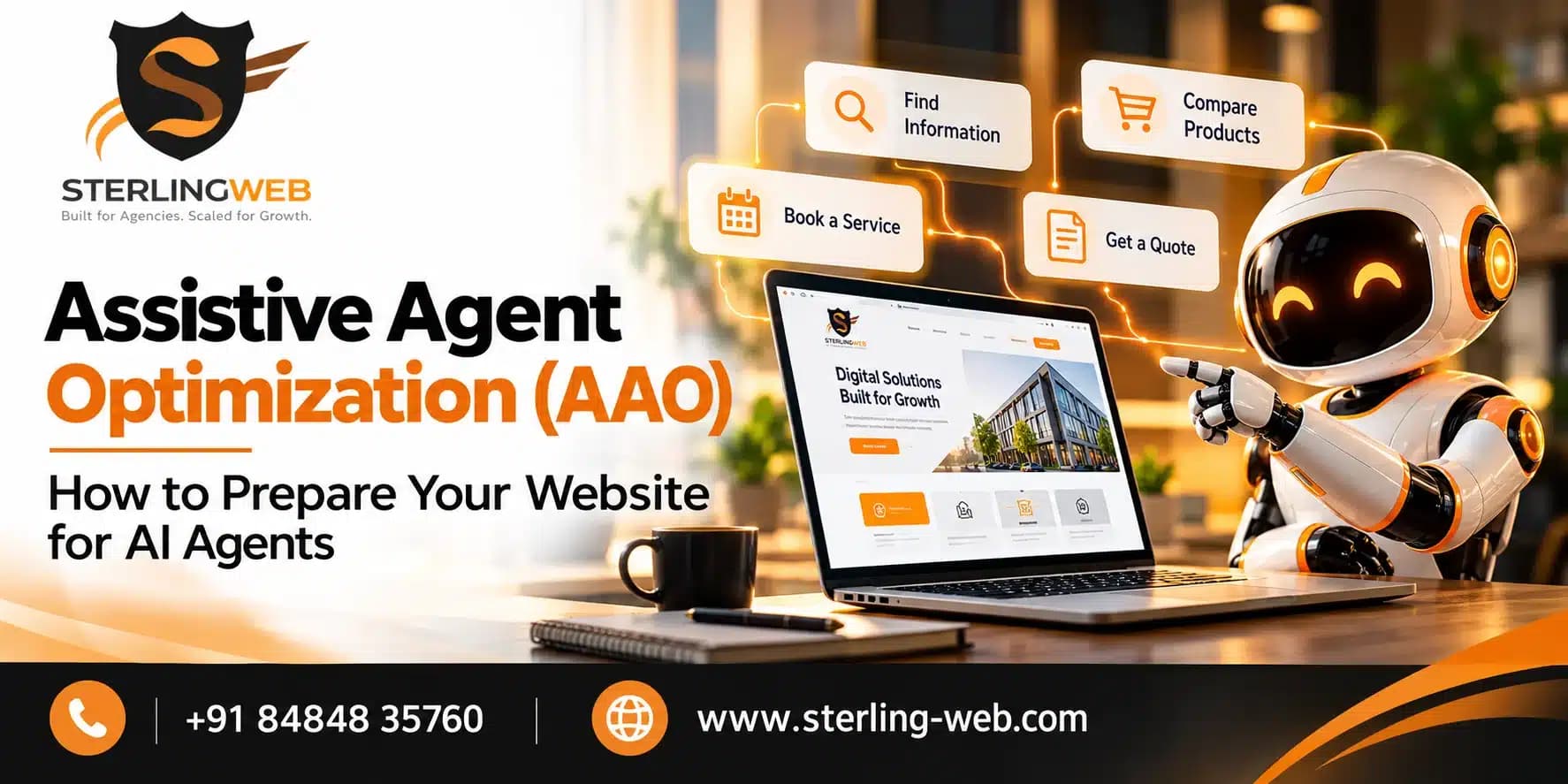
AI-powered search is evolving beyond finding web pages and generating answers. Some AI systems can also navigate websites, compare information, interact with forms, and assist users with specific tasks when the platform and website support those actions.
This creates a practical challenge for businesses: a website may contain the right information but still be difficult for an AI assistant or agent to interpret or use.
Assistive Agent Optimization (AAO) addresses this challenge by improving how websites present information, expose interface controls, and support predictable, accessible user journeys.
Key Finding
Assistive Agent Optimization is SterlingWeb’s methodology for improving website readiness for AI-assisted discovery, evaluation, and supported task completion. It complements SEO, Answer Engine Optimization (AEO), and Generative Engine Optimization (GEO), but it does not replace them.
Quick Answer: What Is Assistive Agent Optimization?
Assistive Agent Optimization (AAO) is a practical approach to making websites easier for AI assistants and agents to read, understand, and use. It focuses on clear information, consistent business and product facts, accessible interfaces, reliable website workflows, and repeatable testing.
AAO is an emerging methodology rather than a universally standardized SEO discipline. It does not guarantee search rankings, AI citations, business recommendations, or successful task completion across every AI platform.
Why Does Assistive Agent Optimization Matter?
Traditional SEO primarily focuses on helping search engines discover, understand, and rank web pages. AI-powered experiences introduce additional ways users may interact with information.
Depending on the platform, an AI assistant might help someone:
- Compare products using price, features, availability, or specifications.
- Identify a suitable supplier based on certifications and business requirements.
- Understand software capabilities and compare subscription plans.
- Find a service provider and review its location, opening hours, or policies.
- Navigate to a quotation form, booking page, or supported purchasing workflow.
However, finding a website does not necessarily mean an AI system can interpret every detail correctly or complete a task on it. Information may be unclear, inconsistent, inaccessible, or difficult to reach.
For businesses, the practical opportunity is to reduce these barriers while maintaining a useful experience for human visitors.
How AAO Differs from SEO, AEO, and GEO
These approaches overlap, but each has a different primary focus.
| Approach | Primary focus |
|---|---|
| Search Engine Optimization (SEO) | Search engine discovery, indexing, rankings, and organic visibility |
| Answer Engine Optimization (AEO) | Presenting clear answers to questions users ask |
| Generative Engine Optimization (GEO) | Improving the accuracy and visibility of brand information in generative AI responses |
| Assistive Agent Optimization (AAO) | Improving website readability, interface accessibility, and readiness for supported AI-assisted tasks |
These labels are useful for explaining different areas of work, but they are not all universally standardized disciplines with agreed definitions.
AAO builds on many familiar website practices, including semantic HTML, accessible forms, clear content, consistent information, and relevant structured data. Its additional emphasis is testing whether defined website tasks can be completed under specified conditions.
Six Areas to Consider When Preparing a Website for AI Agents
1. Clear, Accessible Website Content
Important information should be easy to locate and understand.
Product specifications, service descriptions, pricing details, eligibility requirements, policies, and contact information should use clear headings and descriptive language.
Businesses should also ensure that essential content is available in accessible, crawlable formats rather than relying exclusively on images, inaccessible documents, or interactions that some systems may not handle.
The objective is to improve clarity and accessibility, not to create a separate version of the website solely for AI.
2. Consistent Business and Product Information
Conflicting information can create problems for both people and automated systems.
For example, an ecommerce store might display one price on a product page and another in its structured data. A service business might list different opening hours across its website and business profiles.
Businesses should review important details such as:
- Business name and contact information.
- Product attributes, prices, variants, and availability.
- Service descriptions and eligibility requirements.
- Shipping, refund, and cancellation policies.
- Qualifications, certifications, and relevant credentials.
Keeping information consistent makes it easier for visitors and systems to interpret the business accurately.
3. Relevant Structured Data
Structured data can help search engines interpret specific information about a page or entity.
Depending on the page, relevant types may include Organization, Product, Service, and other supported schema types.
However, structured data must accurately reflect the visible page content and follow the relevant platform’s requirements. Adding schema does not guarantee that an AI assistant will select, cite, recommend, or interact with a website.
Google’s official guidance confirms that its AI search features do not require special AI-specific schema or additional technical optimization beyond established search requirements.
4. Crawlability and Reliable Rendering
Important information should be accessible to the systems intended to retrieve it.
Technical reviews may examine:
- Whether important pages can be crawled and indexed.
- Whether robots.txt or other access controls block intended discovery.
- Whether key information is available in rendered page content.
- Whether navigation and internal links expose important pages.
- Whether essential content depends on fragile scripts or interactions.
- Whether canonical tags, redirects, and page responses behave as intended.
The appropriate checks depend on the platform. A crawler’s ability to access a page does not establish that every AI agent can interpret or use it.
5. Accessible Interfaces and Predictable Workflows
A website may present accurate information yet still have an unusable form or checkout process.
Common issues include buttons without descriptive names, unclear form labels, confusing validation messages, keyboard-inaccessible navigation, and workflows that fail when a user interacts differently from the expected path.
Improving semantic HTML, accessible names, keyboard operation, error handling, and predictable interaction states can help people using assistive technologies and may also make interfaces easier for compatible automated systems to interpret.
These improvements should be tested with real accessibility tools and the specific AI-agent environments in scope. Accessibility compliance alone does not guarantee agent compatibility.
6. Task-Level Testing and Measurement
AAO should be measured through defined tests rather than an unexplained universal score.
For example, a B2B company could test whether a supported agent can locate a specification, verify a certification, and navigate to a quotation form.
A test plan should record:
- The exact task and criteria for success.
- The AI agent or browser environment used.
- The site version and relevant test conditions.
- The number of attempts.
- Successful completions and failure categories.
- The date of each test.
One useful metric is task completion rate:
Task completion rate = Successful eligible task attempts ÷ Total eligible task attempts × 100
Results should be compared under reasonably consistent conditions. Changes in agent capabilities, website versions, authentication, or testing environments can affect the outcome.
Practical AAO Examples Across Industries
The following scenarios illustrate possible testing opportunities; they are not claims of guaranteed results.
Ecommerce: A business reviews whether product descriptions, variants, prices, stock information, and policies are consistent. It then tests supported product comparison or checkout workflows.
B2B and manufacturing: A supplier makes specifications and certifications easier to locate and checks whether a supported workflow can navigate to its quotation form.
SaaS: A software company clarifies feature limits, integrations, documentation, and pricing tiers so users and compatible systems can compare plans more accurately.
Professional services: A business makes service areas, qualifications, consultation options, and contact information easier to understand and tests its booking workflow for accessibility and usability.
In every case, the objective is to improve information quality and test defined interactions—not to assume that every AI assistant can independently complete the journey.
Common Misconceptions About Assistive Agent Optimization
Myth 1: AAO is a confirmed Google ranking factor.
There is no established evidence that AAO, as a named methodology, is a direct Google ranking factor. Google recommends established SEO fundamentals for its AI search experiences.
Myth 2: Every AI assistant can navigate and transact on every website.
Capabilities vary by platform, model, tools, permissions, and website implementation. Some systems may only retrieve and summarize information.
Myth 3: Every website needs an API or an llms.txt file.
Not necessarily. Many useful improvements involve ordinary website content, HTML, accessibility, structured data, and testing. APIs or integrations may be appropriate for particular workflows. An llms.txt file is optional and should not be treated as a universal requirement.
Myth 4: AAO guarantees AI recommendations or sales.
No optimization methodology can guarantee how an AI platform selects businesses or whether a visitor converts. Outcomes depend on many factors outside a website owner’s control.
How Businesses Can Prepare for the Future
Businesses do not need to rebuild their websites simply because AI agents are developing.
A sensible starting point is to review the website’s technical accessibility, content clarity, business information, structured data, and most important customer workflows.
From there, teams can identify specific tasks worth testing and prioritize fixes based on severity, business value, and measurable results.
For ecommerce and B2B businesses, these priorities might include product comparison, quotation requests, or supported purchasing journeys. For service businesses, they may include finding accurate service details, accessing contact information, or navigating an appointment form.
The right approach depends on the website, audience, business goals, and capabilities of the systems being tested.
Frequently Asked Questions
What is Assistive Agent Optimization?
Assistive Agent Optimization is SterlingWeb’s methodology for improving how AI assistants and agents read, understand, and use websites for supported tasks. It includes information clarity, accessible interfaces, consistent business facts, and repeatable testing.
Is AAO the same as SEO?
No. SEO focuses on search discovery, indexing, and visibility. AAO focuses on website readiness for AI-assisted interpretation and supported interactions. They overlap and can complement each other.
Is AAO an official industry standard?
No. AAO is an emerging methodology without a universal governing standard. SterlingWeb uses the term to describe its approach to website readiness and task-level testing.
Does AAO improve visibility in ChatGPT, Gemini, or Perplexity?
Clear information and sound technical practices can support a website’s accessibility and discoverability, but AAO does not guarantee inclusion, citations, or recommendations in any particular AI platform.
Does a website need special schema or an API for AAO?
Not universally. Relevant structured data and APIs may help particular use cases, but the appropriate implementation depends on the website and task. Google states that its AI search features do not require special AI-specific schema.
How is AAO success measured?
It can be measured through defined task-completion rates, failure categories, information accuracy, resolved technical issues, and repeatable before-and-after tests. AI visibility and website usability should be reported as separate metrics.
Conclusion
As AI-assisted discovery and task-oriented tools evolve, businesses have a practical reason to make their websites clearer, more accessible, and more reliable.
Assistive Agent Optimization provides one framework for examining these areas, from the accuracy of business information to the usability of important website workflows. It complements established SEO, AEO, and GEO practices without replacing them.
The most credible approach is to identify real barriers, implement relevant improvements, test defined tasks, and report measurable outcomes without promising universal AI compatibility or guaranteed rankings.
About SterlingWeb
SterlingWeb helps businesses improve website performance, search visibility, and readiness for AI-assisted customer journeys. Its AAO services include readiness audits, content and entity reviews, accessibility-focused engineering, workflow testing, and ongoing monitoring.
Explore the Assistive Agent Optimization services at SterlingWeb.
Sources and Further Reading
- SterlingWeb: Assistive Agent Optimization Services — SterlingWeb’s definition, methodology, services, and limitations.
- Google Search Central: AI Features and Your Website — Official guidance on AI Overviews, AI Mode, and established SEO fundamentals.
- OpenAI: Overview of OpenAI Crawlers — Official documentation about OpenAI’s web crawlers and ChatGPT search discovery.
- Google Search Central: Guidance on Generative AI Content — Guidance on useful content and compliance with Search policies.