

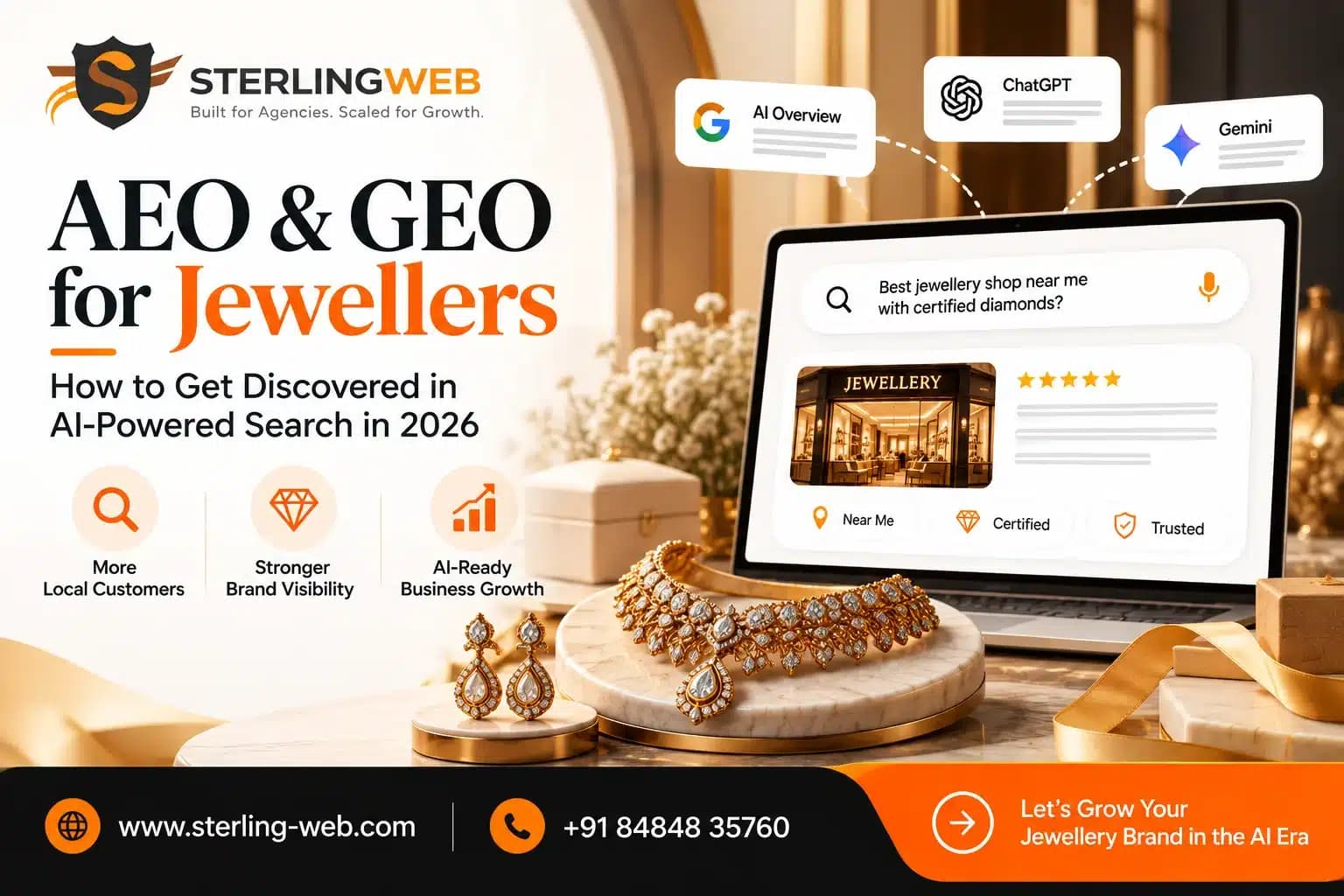
A customer looking for jewellery today may still search for “jewellery shop near me”, “diamond jewellery store in Mumbai”, or “best gold jeweller in Pune.”
But search behaviour is becoming more conversational.
A potential buyer might instead ask:
“Which jewellery stores near me offer certified diamond jewellery and have strong customer reviews?”
Or:
“Where can I find traditional gold jewellery for a wedding in Mumbai?”
These searches require search engines and AI-powered experiences to understand much more than a keyword. They need context about the brand, products, location, expertise, reputation, and customer intent.
This is where Answer Engine Optimization (AEO) and Generative Engine Optimization (GEO) become increasingly relevant for jewellery brands.
Google’s current guidance specifically addresses optimization for generative AI features and emphasizes that established SEO fundamentals continue to matter. Its guidance also covers local, shopping, image, and video content—areas particularly relevant to jewellery businesses.
The question for jewellers is therefore shifting from:
“How do we rank for jewellery keywords?”
to:
“How clearly can search engines and AI systems understand our jewellery brand when a potential customer asks a relevant question?”
What Are AEO and GEO for Jewellers?
Answer Engine Optimization (AEO) focuses on making content and business information useful and understandable when customers search through questions and answer-focused experiences.
Generative Engine Optimization (GEO) takes a broader view of visibility in generative AI experiences, where information from multiple sources can be synthesized into an answer.
For a jewellery brand, these strategies complement—not replace—traditional SEO.
For example, traditional SEO may target:
“diamond jewellery in Mumbai”
AEO considers questions such as:
“Where can I buy certified diamond jewellery in Mumbai?”
GEO considers the broader digital information surrounding the brand:
- What jewellery does the company specialize in?
- Where is it located?
- Does it sell online?
- What products does it offer?
- What do customers say about it?
- Is the brand mentioned by credible sources?
- Does its website clearly explain its expertise?
The goal is not to guarantee an AI recommendation. Instead, it is to create a clear, accurate, useful, and credible digital presence that search systems can understand.
Why Jewellery Search Is Changing
Jewellery is a highly considered purchase.
Customers often research extensively before visiting a store or placing an order.
They may want answers about:
- Gold purity
- Diamond quality
- Certifications
- Jewellery designs
- Customization
- Pricing
- Making charges
- Return policies
- Warranty
- Shipping
- Store locations
- Reviews
- Brand reputation
- Bridal jewellery
- Investment considerations
This creates a large number of potential question-based searches.
Instead of optimizing a website only around “gold jewellery”, a jewellery brand can address genuine customer questions such as:
What is the difference between 18K and 22K gold?
How do I choose a diamond engagement ring?
What should I check before buying gold jewellery?
How do I choose jewellery for a wedding?
What does diamond certification mean?
These topics provide opportunities to demonstrate actual expertise rather than simply repeating keywords.
SEO Still Provides the Foundation
AEO and GEO should not be treated as replacements for SEO.
For jewellery businesses, traditional SEO remains essential for making websites crawlable, understandable, and relevant to search queries.
Google’s current guidance for generative AI search explicitly says that its existing SEO best practices remain relevant to generative AI features.
That means jewellers should continue investing in:
- Technical SEO
- Search intent research
- Product page optimization
- Internal linking
- Mobile performance
- Helpful content
- Image optimization
- Structured data
- Local SEO
- Website architecture
The difference is that these fundamentals now need to support a wider range of search experiences.
Local SEO Matters for Jewellery Stores
For a jewellery business with physical stores, local search remains critical.
Google says local results are primarily influenced by relevance, distance, and prominence. It also recommends maintaining complete and accurate Business Profile information so customers can understand what the business does, where it is located, and when they can visit.
For a jeweller, that means keeping information such as these accurate:
- Store name
- Address
- Phone number
- Opening hours
- Website
- Business category
- Jewellery services
- Store locations
- Photos
- Products where applicable
Local SEO gives AI-powered search experiences a stronger foundation from which to understand the business.
Your Digital Presence Is Bigger Than Your Website
One important consideration for AEO and GEO is that search systems do not necessarily rely on one webpage to understand a business.
Google explains that local listing information can be compiled from publicly available web content, third-party data, user contributions, reviews, photos, and information from interactions with businesses. Google may also generate AI summaries for local listings from these sources.
For jewellery brands, this makes consistency particularly important.
Imagine a jewellery business whose website describes it as a specialist in:
Bridal jewellery + diamond jewellery + custom jewellery
But important third-party profiles provide incomplete or contradictory information.
That creates a less consistent digital picture of the brand.
A strong GEO strategy therefore looks beyond one website page and considers the broader online entity.
Create Content Around Jewellery Buying Questions
AEO gives jewellery businesses an opportunity to rethink their content strategy.
Rather than asking only:
“Which jewellery keyword should we target?”
ask:
“What does our customer need to know before making a jewellery decision?”
For example, a jewellery brand could develop useful resources around:
Gold Jewellery
- How gold purity is measured
- 18K vs 22K gold
- How to care for gold jewellery
- What to check before purchasing gold jewellery
- Choosing gold jewellery for different occasions
Diamond Jewellery
- Understanding the 4Cs
- How to choose an engagement ring
- Diamond certification explained
- Natural vs lab-grown diamonds
- Choosing diamond jewellery for different budgets
Bridal Jewellery
- How to plan a bridal jewellery collection
- Jewellery for different wedding ceremonies
- Traditional vs contemporary bridal jewellery
- Matching jewellery with bridal outfits
- Choosing jewellery for a specific wedding style
The objective isn’t to publish content simply to increase the number of indexed pages.
The objective is to answer meaningful customer questions with genuine expertise.
Product Pages Are an AEO Opportunity
Jewellery ecommerce websites should pay particular attention to individual product pages.
A beautiful product image is important, but search engines also need understandable product information.
A strong product page should clearly communicate:
What is it?
What material is it made from?
What are its specifications?
What size or variants are available?
What does it cost?
Is it available?
What are the relevant policies?
Google’s Product structured-data documentation explains that eligible product pages can provide information such as price, ratings, reviews, and availability in search features.
For jewellery websites, this makes accurate product data an important part of technical SEO and search visibility.
Structured Data Helps Search Engines Understand Jewellery Websites
Technical SEO also has a role in AEO and GEO.
Structured data provides search engines with standardized information about page content.
For a jewellery business, relevant implementations may include:
- Product
- Organization
- LocalBusiness
- Offer
- Review-related markup where applicable
- Product variants where applicable
Google explains that structured data can help it understand page content and may support richer search experiences.
For local jewellery stores, LocalBusiness structured data can communicate information such as business details, hours, and location-related information.
However, structured data should accurately reflect information on the page.
It should be treated as a clarity mechanism, not an AI-ranking shortcut.
Reviews Are Important for Jewellery Brands
Trust matters enormously when customers are considering jewellery.
Reviews can provide useful context about:
- Product quality
- Store experience
- Staff service
- Customization
- Delivery
- After-sales support
- Product selection
Google’s local search documentation notes that reviews contribute to how businesses are represented in local search, while Google also uses information from reviews and other sources in local listings.
For AEO and GEO, the focus should be on authentic customer experiences.
Jewellery businesses should not try to manufacture reviews around keywords.
Google explicitly states that reviews should reflect genuine experiences and prohibits incentivized or fake engagement.
Real customer feedback is more valuable for building long-term trust.
Build a Strong Jewellery Brand Entity
GEO requires thinking beyond individual keywords.
Think about the jewellery brand as a digital entity.
Its identity may appear across:
Website → Google Business Profile → Product pages → Reviews → Social profiles → Local directories → Industry publications → Editorial mentions
Each source can contribute context.
For example:
A brand might consistently be associated with:
Gold jewellery + bridal jewellery + custom designs + Pune
That is more meaningful than simply repeating:
“Best jewellery shop in Pune.”
The goal is to build a recognizable and accurate digital identity around the brand’s actual expertise.
AEO Should Match Different Search Intents
Jewellery searches can occur at different stages of the buying journey.
Informational Search
“What is 22K gold?”
The customer wants education.
Commercial Research
“Best diamond jewellery brands for engagement rings”
The customer is comparing options.
Transactional Search
“Buy diamond earrings online”
The customer may be ready to purchase.
Local Search
“Gold jewellery shop near me”
The customer may be looking for a nearby store.
A good SEO + AEO strategy should address these different intents instead of creating one page and expecting it to answer every question.
GEO Is About More Than ChatGPT Mentions
A common misunderstanding is that GEO simply means trying to get a brand mentioned by ChatGPT or another AI platform.
That is too narrow.
A more useful approach is to strengthen the information ecosystem surrounding the brand.
For a jewellery company, GEO can include:
- Clear brand information
- Expert jewellery content
- Detailed product information
- Strong local signals
- Consistent business information
- Credible third-party mentions
- Authentic reviews
- Relevant structured data
- Strong topical authority
The goal is to make the brand easy to understand and accurately represent.
There is no guaranteed formula for making an AI system recommend a specific jewellery brand.
Jewellery Brands Should Also Think Visually
Jewellery is an inherently visual category.
Customers want to see:
- Product details
- Close-up designs
- Different angles
- Jewellery worn by models
- Bridal styling
- Product videos
- Design variations
This makes image and visual search increasingly relevant.
Google’s September 2026 Search Console update introduced reporting for web multimodal search, including searches involving Google Lens, Circle to Search, image uploads, and other visual search interactions.
For jewellery websites, that makes image optimization worth treating as part of the wider search strategy.
Consider:
- Descriptive image filenames
- Accurate alt text
- High-quality product photography
- Consistent product information
- Relevant surrounding content
- Structured product information
A jewellery website should make its visual content useful to both customers and search systems.
What Should Jewellery Brands Measure?
Traditional rankings remain useful, but they don’t provide the complete picture.
SEO Visibility
Monitor:
- Organic clicks
- Impressions
- Search rankings
- Product page performance
- Organic landing pages
- Local visibility
AEO Visibility
Monitor:
- Visibility for conversational questions
- Coverage of important customer questions
- Search appearances for informational queries
- Brand visibility in answer-focused experiences
GEO Visibility
Look at:
- How the brand is represented in generative search
- Relevant citations and references
- Brand/entity consistency
- Third-party mentions
- Accuracy of AI-generated descriptions where observable
The measurement framework should evolve as search interfaces evolve.
Common AEO & GEO Mistakes Jewellers Should Avoid
1. Creating Keyword-Heavy Content
Repeating phrases such as “best jewellery shop” doesn’t demonstrate expertise.
Answer real customer questions instead.
2. Creating Generic Location Pages
Creating nearly identical pages for dozens of cities can create a poor user experience.
A location page should exist because the business genuinely serves that market and can provide useful local information.
3. Ignoring Product Information
Product pages should provide enough information for customers and search engines to understand what is actually being sold.
4. Treating GEO as a Shortcut
There is no guaranteed technique for forcing AI systems to recommend a business.
Build credibility instead.
5. Ignoring Local SEO
For physical jewellery stores, Google Business Profile, accurate business information, reviews, local relevance, and website SEO remain important. Google’s own local guidance continues to emphasize relevance, distance, and prominence.
SEO + AEO + GEO: A Connected Strategy for Jewellers
The three disciplines can work together.
SEO builds the foundation.
It helps search engines crawl, interpret, index, and rank relevant content.
AEO answers customer questions.
It makes important information easier to discover in conversational and answer-focused searches.
GEO strengthens generative search visibility.
It focuses on how the brand, products, expertise, and information are represented across AI-powered discovery experiences.
For jewellery brands, the goal is not simply to rank for more keywords.
It is to become a clear, relevant, and trustworthy answer to the questions potential customers are already asking.
How SterlingWeb Approaches SEO, AEO & GEO for Jewellers
At SterlingWeb, our approach to SEO, AEO, and GEO focuses on the changing relationship between customers, traditional search, and AI-powered discovery.
For jewellery businesses, that means looking beyond conventional keyword rankings and considering the complete visibility ecosystem:
Technical SEO + Local SEO + Product SEO + AEO + GEO + Entity Optimization
We focus on helping search systems better understand the jewellery brand, its products, expertise, locations, and customer relevance.
The objective isn’t to chase every new AI feature.
It is to build a strong search foundation that can adapt as the way customers discover and evaluate jewellery continues to change.
The Future of Jewellery Search Is About Being Understood
AI-powered search is changing how people can discover businesses and products.
But the fundamentals remain important.
Jewellery brands still need:
- A technically sound website
- Accurate business information
- Helpful product pages
- Genuine customer reviews
- Strong local visibility
- Expert content
- Clear product data
- Consistent brand information
What is changing is the way these signals can be combined and presented to customers.
That’s why AEO and GEO should not be treated as isolated tactics.
They are part of a broader approach to making a jewellery brand discoverable across multiple search experiences.
Key Takeaway
In 2026, jewellery search is moving beyond traditional rankings toward a broader visibility ecosystem involving search engines, local discovery, product search, visual search, and generative AI.
Jewellers that invest in strong SEO foundations, useful answers, accurate product information, local authority, and a consistent digital identity can build a stronger foundation for this evolving search environment.
Want to explore how SEO, AEO, and GEO can improve your jewellery brand’s visibility across AI-powered search? Connect with SterlingWeb to build a search strategy around your products, customers, and market.