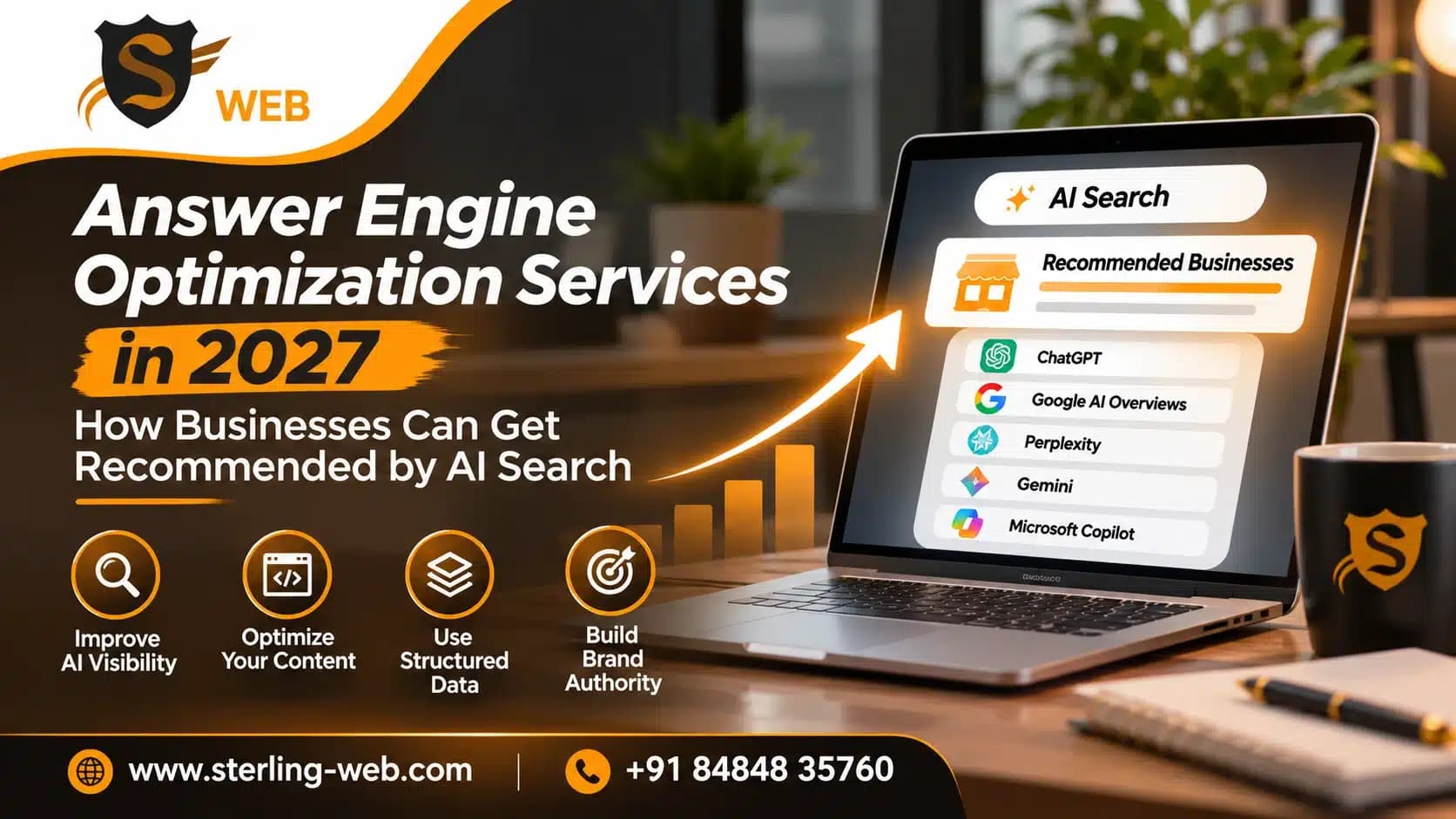
Imagine a potential customer asking ChatGPT, “Which company provides reliable Shopify development services in India?” Your business may have a well-designed website, useful blog content and good Google rankings. But if AI-powered search does not identify your brand as a relevant source, that customer may discover your competitors instead.
This is a new visibility challenge for businesses.
People can now use AI-powered search experiences to research companies, compare services, understand products and find solutions. Instead of browsing several websites, they may receive a summarised answer with links to selected sources.
For businesses, this creates an important question: Is your brand visible when potential customers search for your services through AI?
Answer Engine Optimization (AEO) helps businesses improve how their information is discovered, understood and presented in answer-focused search experiences. In 2027, it should be considered alongside traditional SEO, not as a replacement for it.
Quick Answer: What Are Answer Engine Optimization Services?
Answer Engine Optimization services help businesses make their website content and brand information easier to discover, understand and reference in AI-powered search experiences. They include technical SEO reviews, content improvements, structured data checks, brand information management and AI visibility monitoring. The objective is to improve the opportunity for a business to appear as a relevant source in AI-generated answers—not to guarantee recommendations or citations.
Key Findings
- Traditional SEO remains an important foundation for visibility in Google’s AI search experiences.
- AI platforms use different search and retrieval systems, so visibility can vary between platforms.
- Clear, original and useful content gives search systems better information to understand.
- Technical accessibility matters. A blocked crawler or non-indexable page can limit discovery.
- AI visibility should be measured through multiple indicators, including citations, brand mentions, referral traffic and conversions.
1. Why Businesses Need Answer Engine Optimization Services in 2027
The way customers research businesses is changing.
A customer looking for a digital marketing agency might search Google for “SEO agency in India.” They might also ask an AI assistant:
- Which SEO agencies offer AEO and GEO services?
- Which company can improve my website’s visibility in ChatGPT?
- What should I look for when choosing an AI SEO agency?
- Which Shopify development agency works with international businesses?
These questions are more conversational and often include several requirements.
Traditional search results generally present a list of web pages. AI-powered search experiences can combine information from different sources into a response, sometimes with links to supporting pages.
This changes the visibility opportunity.
A business does not only want its website to appear in search results. It also wants accurate information about its services, experience and expertise to be discoverable when customers research relevant questions.
Why traditional rankings are not the whole picture
A good Google ranking can bring valuable visitors, but it does not automatically mean that an AI platform will mention or recommend the same business.
Each platform has its own systems and sources. A page may be indexed in Google but still not appear in a particular ChatGPT or Perplexity response.
This is why businesses should monitor both traditional search performance and AI search visibility.
2. How AI Search Engines Discover and Present Business Information
Before investing in AEO services, it is useful to understand how AI-powered search experiences work.
There is no single process shared by every platform. However, several general stages help explain how websites can become potential sources.
Website discovery and crawling
Search systems need ways to discover website information.
Crawlers visit accessible pages and collect content that may be processed for search or other services. Website owners can influence access through technical settings such as robots.txt, server permissions and indexing directives.
For example, OpenAI documents the OAI-SearchBot crawler and explains that publishers should allow it to access their content if they want that content to be eligible for inclusion in ChatGPT search summaries and snippets.
A website that unintentionally blocks relevant crawlers may limit its opportunities for discovery.
Content retrieval and relevance
When a user asks a question, a search system may retrieve information that appears relevant to the request.
For example, someone asking about Shopify Plus development in India needs information related to Shopify Plus, development capabilities and the relevant market.
A page that clearly explains those services is more useful than a page containing repeated keywords without meaningful details.
Google explains that its AI search features use its existing Search systems and may explore related searches to develop responses. This is one reason why clear website architecture and useful supporting content remain important.
Understanding the business or brand
AI systems may encounter information about a business across its website and other online sources.
This can include its business name, services, location, product information and published expertise.
Consistent information helps reduce confusion. If a company describes its services differently across its website, business profiles and other platforms, customers may also find it harder to understand what the company actually offers.
Selecting sources and presenting answers
AI-generated answers may include links or citations to supporting sources. However, the sources selected can change according to the question, platform and available information.
A page being indexed does not guarantee that it will be cited. Similarly, there is no publicly established formula that guarantees a business will be recommended by every AI assistant.
The practical goal of AEO is to improve the quality, accessibility and relevance of the information available about a business.
3. What Do Professional Answer Engine Optimization Services Include?
A professional AEO strategy should address more than blog writing. It should examine the website, the brand’s online information and the way visibility is measured.
Here are the major areas businesses should expect from a comprehensive AEO service.
AI search visibility audit
An AI visibility audit examines how a brand appears across selected AI platforms.
It can include questions such as:
- Does the platform mention the business?
- Does it describe the company’s services correctly?
- Which competitors appear in similar answers?
- Are any website pages cited?
- Is the brand information accurate?
The audit establishes a starting point for future comparisons. Results should be recorded across a consistent set of prompts and platforms.
Technical SEO and crawlability
Useful content cannot help if search systems cannot access the relevant pages.
A technical review should examine:
- Robots.txt and crawler access.
- Noindex directives.
- Canonical URLs.
- XML sitemaps.
- Internal linking.
- Mobile usability and page experience.
- Server responses and rendering.
- Important content available in readable text.
These checks support traditional search accessibility as well as eligibility for relevant AI search experiences.
Content and answer optimization
AEO content should answer real customer questions clearly.
For example, a company offering technical SEO services should explain:
- What technical SEO includes.
- Which website problems it addresses.
- How technical audits are conducted.
- What types of businesses need the service.
- How performance is evaluated.
The content should provide enough detail to help readers make informed decisions.
Short answers can be useful, but adding meaningful explanations, practical examples and original insights makes the page more valuable.
Structured data and schema review
Structured data helps search engines understand information about a page and its entities.
Depending on the content, relevant schema types may include Organization, LocalBusiness, Product, Service, Article and BreadcrumbList.
However, schema markup should accurately represent the visible information on the page.
It is not a shortcut to AI recommendations. Google specifically states that there is no special schema markup required to appear in AI Overviews or AI Mode.
Brand information and entity consistency
Businesses should review how their names, services, locations and contact details appear across their online presence.
This may include:
- Official website pages.
- Business profiles.
- Company directories.
- Professional social profiles.
- Relevant industry platforms.
- Product or service listings.
The goal is to provide accurate, consistent information. AEO should not involve creating artificial brand mentions or submitting the same content to irrelevant directories.
Brand mentions and citation analysis
An AEO agency can monitor where a business is mentioned and which pages are cited in AI-generated answers.
This helps identify content gaps and useful external sources.
For example, if competitors are repeatedly referenced for a particular service, the business can investigate what information those sources provide and whether it has stronger, original information to contribute.
The purpose is to understand the visibility gap—not to copy competitors.
4. How to Improve Business Visibility Across AI Search Platforms
Different AI platforms have different search experiences. Businesses should understand their individual requirements instead of assuming one optimization technique works everywhere.
ChatGPT Search
ChatGPT Search can provide answers with links to relevant web sources.
OpenAI explains that website owners should allow OAI-SearchBot to crawl their content if they want their pages to be eligible for inclusion in ChatGPT search summaries and snippets.
Businesses should review their robots.txt rules, CDN and hosting security settings to ensure legitimate crawler access.
They should also publish clear service pages, accurate business information and useful supporting content.
OpenAI also documents the utm_source=chatgpt.com parameter in ChatGPT referral URLs. This can help businesses identify traffic arriving from ChatGPT in their analytics reports.
Important: Allowing the crawler makes content eligible for consideration. It does not guarantee that a website will appear in an answer.
Google AI Overviews and AI Mode
Google’s guidance is particularly important for businesses investing in AEO.
Google states that the same foundational SEO best practices remain relevant for its AI features. Pages must meet the normal technical requirements for Google Search and be eligible to appear with a snippet.
Google recommends:
- Making important content accessible in text form.
- Allowing crawling and indexing.
- Creating helpful, reliable, people-first content.
- Using clear internal links.
- Ensuring structured data matches visible page content.
- Keeping relevant business and merchant information updated.
Google also advises against unnecessary AI-specific files or special schema intended to influence AI features.
This means businesses should improve their actual website quality rather than chase unsupported AEO shortcuts.
Perplexity
Perplexity provides answer-focused search experiences that can reference web sources.
For businesses, the practical priorities include accessible website content, clear explanations, accurate information and useful pages that address specific customer questions.
It is also worth checking crawler access and website security settings using the platform’s current publisher documentation.
Do not assume that appearing in Google results guarantees visibility in Perplexity.
Gemini
Gemini is Google’s AI assistant, while Google AI Overviews and AI Mode are AI-powered features within Google Search.
These experiences should not be treated as identical.
Businesses should maintain strong website content and accurate information across their online presence. Google Search fundamentals remain relevant to its search-based AI experiences, but a particular website page is not guaranteed to appear in every Gemini response.
Microsoft Copilot
Microsoft’s search-related AI experiences can draw on Bing search information.
Bing Webmaster Guidelines are therefore useful for businesses that want their pages to be discoverable across Bing-powered experiences.
Businesses should review sitemap accuracy, crawlability, indexing, URL structure and content quality.
Microsoft’s guidance also emphasises that content should be original, clear and useful rather than artificially written to trigger AI responses.
5. AEO vs SEO vs GEO: Understanding the Differences
SEO, AEO and GEO are closely related, but they describe different areas of search visibility.
| Area | SEO | AEO | GEO |
|---|---|---|---|
| Main objective | Improve visibility in search engines | Improve the opportunity to appear in direct answers | Improve visibility in generative AI responses |
| Search experience | Traditional search results | Answer-focused search | AI-generated summaries and responses |
| Content approach | Relevant, useful and search-focused content | Clear answers to user questions | Useful, credible content that AI systems can retrieve and reference |
| Measurement | Rankings, clicks, impressions and conversions | Answer visibility, mentions and citations | AI mentions, citations, referral traffic and brand presence |
| Business value | Organic discovery and website traffic | Visibility when customers seek direct answers | Brand discovery across generative AI experiences |
These approaches should support one another.
Traditional SEO helps search systems discover and understand website content. AEO focuses on how clearly that content answers questions. GEO considers how a brand and its information appear across generative AI experiences.
For most businesses, an integrated SEO, AEO and GEO strategy is more practical than treating them as completely separate activities.
6. How to Measure the Results of Answer Engine Optimization Services
AEO performance cannot be judged using Google rankings alone.
Businesses need a measurement framework that considers both AI visibility and actual business outcomes.
AI brand mentions
Track whether selected AI platforms mention your business when users ask relevant questions.
For example, a Shopify development agency might monitor prompts such as:
- Which Shopify development agencies work with international brands?
- Which companies offer Shopify Plus development?
- Where can a business hire Shopify developers in India?
Use the same prompts over time so that comparisons are more meaningful.
Citation frequency and cited pages
Record how often your website is cited and which URLs are referenced.
This can reveal whether your service pages, blog articles or other resources are being used as supporting sources.
Competitor visibility
Compare your brand with a defined set of relevant competitors.
Look at which companies appear, which sources are cited and how their services are described.
A competitor appearing more frequently in a limited prompt test does not prove that it has greater overall AI visibility. It is a signal worth investigating.
Accuracy of brand information
Check whether AI platforms correctly describe your services, location, contact details and business offerings.
Incorrect information can create confusion for potential customers, even when your brand is mentioned.
AI referral traffic and conversions
Use Google Analytics or another analytics platform to identify visitors arriving from AI platforms.
OpenAI documents a utm_source=chatgpt.com referral parameter for ChatGPT search traffic.
Track what those visitors do after arriving: which pages they visit, whether they submit enquiries and whether they become customers.
Google Search Console reporting
Google’s Search Console now provides a Generative AI performance report for supported Search experiences, including AI Overviews and AI Mode. The report helps website owners review impressions and identify pages appearing in those experiences.
It is a useful addition to traditional search reporting, but it does not replace wider AI visibility monitoring across platforms such as ChatGPT and Perplexity.
A useful measurement principle: Track visibility, website visits and business outcomes separately. A brand mention is not the same as a website visit, and a website visit is not the same as a qualified lead.
7. Common AEO Mistakes Businesses Should Avoid
AEO is still developing, and businesses can waste time following tactics that are not supported by platform guidance.
Some common mistakes include:
Treating AEO as keyword stuffing: Repeating phrases such as “best AEO company” does not make content more useful. Write for the actual question and intent.
Publishing repetitive AI-generated articles: Producing large volumes of similar content can weaken quality. Review facts, add original experience and give readers information they cannot easily find elsewhere.
Ignoring technical SEO: Important pages should be crawlable, indexable and internally linked. Technical problems can limit discovery.
Assuming schema guarantees AI citations: Structured data helps describe page information, but it does not guarantee recommendations or citations.
Ignoring brand accuracy: Outdated contact details, inconsistent service descriptions and incorrect company information can confuse customers.
Checking only one AI platform: Visibility can differ across platforms. Monitor the services that matter to your audience.
Expecting immediate results: Crawling, indexing, content evaluation and changes in search visibility take time. AEO should be treated as an ongoing activity.
8. How to Choose the Right Answer Engine Optimization Agency
Choosing an AEO agency requires more than checking whether it offers AI SEO as a service.
Businesses should understand how the agency researches, implements and measures its work.
Before hiring an Answer Engine Optimization company, consider the following:
Does it understand technical SEO? The agency should be able to investigate crawling, indexing, website architecture, rendering and structured data.
Does it create useful content? Ask how it develops content based on customer questions, industry knowledge and original information.
Can it explain its AI visibility measurement process? It should define the platforms, prompts, locations and reporting frequency used for monitoring.
Does it understand platform differences? An agency should not promise that one technique will work identically across Google, ChatGPT, Perplexity and Gemini.
Does it provide transparent reporting? Reports should distinguish completed activities, visibility changes, website traffic and actual leads.
Does it set realistic expectations? No agency can guarantee that a business will be recommended by ChatGPT or appear in every AI-generated answer.
A reliable AEO partner should focus on improving the website and brand information while measuring progress honestly.
9. The Future of AEO Services: What Businesses Should Prepare for in 2027
AI-powered search is continuing to develop. Businesses should prepare for a search environment in which customers may discover companies through traditional search results, AI-generated answers and conversational assistants.
Several areas deserve attention in 2027.
More conversational discovery: Customers may ask detailed questions that combine service requirements, budgets, locations and comparisons. Businesses should create content that addresses these real-world questions.
Accurate brand information: Clear descriptions of products, services, locations and expertise will remain important for customers and the systems that retrieve online information.
Better AI visibility measurement: Businesses will need to move beyond occasional manual prompt checks and develop consistent monitoring processes.
Multiplatform visibility: Search behaviour is not limited to one assistant. Companies should understand which AI platforms their customers use and monitor relevant visibility across them.
Original and useful content: Generic articles are easy to reproduce. First-hand experience, original research, meaningful examples and detailed service information can give a website more value.
These are strategic expectations, not guaranteed platform developments. Businesses should review official platform guidance as features and measurement options evolve.
Frequently Asked Questions
1. What are Answer Engine Optimization Services?
Answer Engine Optimization services help businesses improve the accessibility, clarity and usefulness of their online information so that it has a better opportunity to appear in AI-powered answers and answer-focused search experiences.
2. How are AEO services different from traditional SEO?
Traditional SEO focuses on visibility in search engine results. AEO focuses on making information useful and understandable for answer-based experiences. Both rely on strong content and technical foundations.
3. How can a business appear in ChatGPT answers?
Start by making important website pages publicly accessible and ensuring OAI-SearchBot is not blocked if you want content to be eligible for ChatGPT Search. Publish accurate, useful information about your business. However, no method guarantees a mention or citation.
4. Does AEO help businesses appear in Google AI Overviews?
AEO work can support the quality and accessibility of content that may be eligible for Google AI Overviews. Google says its existing SEO best practices remain relevant, but inclusion is not guaranteed.
5. How long does Answer Engine Optimization take?
There is no fixed timeline. Results depend on the website’s current technical condition, content quality, competition, crawling and indexing, and the platforms being monitored. Improvements should be evaluated over time.
6. Does schema markup improve AI search visibility?
Structured data helps search engines understand information on a page. It should accurately describe visible content. However, schema markup alone does not guarantee AI citations or recommendations.
7. How can businesses measure AI search visibility?
Businesses can monitor brand mentions, cited URLs, competitor appearances, AI referral traffic, brand accuracy and conversions. They should use consistent prompts and repeat measurements across relevant platforms.
8. Why should businesses hire an AEO agency in 2027?
An experienced AEO agency can bring technical SEO, content strategy, brand visibility analysis and measurement together. This helps businesses manage AI search visibility as part of a broader digital marketing strategy.
Final Thoughts
Search visibility is no longer limited to appearing in a list of traditional search results. Customers can also discover businesses through AI-generated answers, conversational search and platform recommendations.
For businesses, the priority should be to make their information accessible, accurate, useful and easy to understand.
Answer Engine Optimization services bring together technical SEO, content improvements, brand information management and visibility monitoring. They help businesses prepare for evolving search experiences without relying on shortcuts or unrealistic promises.
SterlingWeb combines SEO, Answer Engine Optimization, Generative Engine Optimization and technical website optimization to help businesses strengthen their online visibility.
If your business wants to understand how it appears across AI-powered search platforms, explore SterlingWeb’s Technical SEO, AEO and GEO Services or contact the SterlingWeb team to discuss your visibility requirements.