
The SEO System That Generates Predictable Leads: A Step-by-Step Framework for Sustainable Business Growth
Many businesses invest in SEO expecting a steady stream of leads, only to end up disappointed. They publish blog posts, target a few keywords, and wait for rankings that never translate into meaningful business growth.
The problem isn’t that SEO has stopped working.
The problem is that most businesses approach SEO as a collection of isolated tactics instead of a complete growth system.
Modern SEO is no longer about ranking for as many keywords as possible. It’s about attracting the right audience, answering their questions, building trust, and guiding them toward becoming customers.
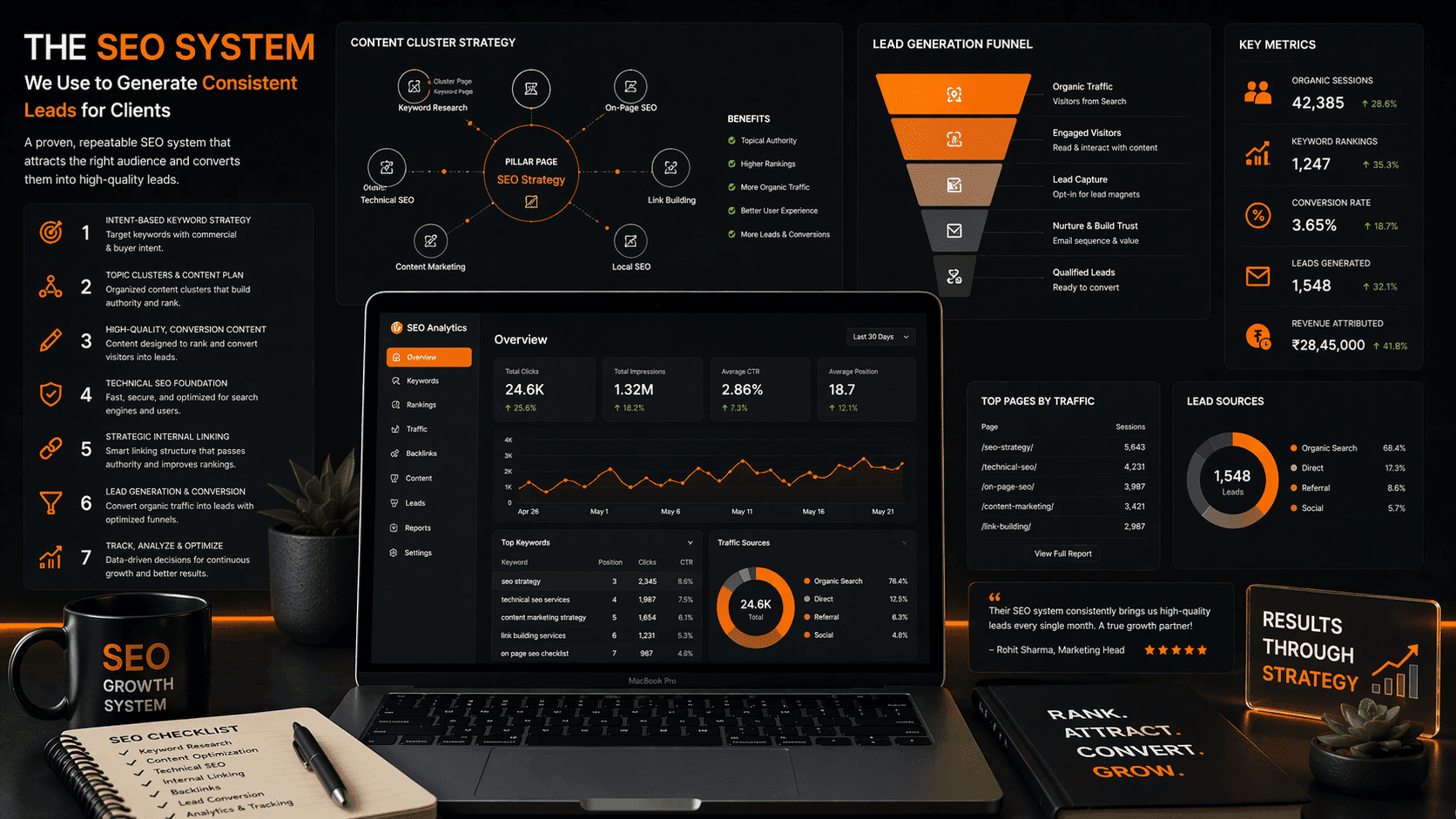
At Sterlingweb Growth Labs, we don’t build SEO campaigns—we build SEO systems. These systems combine keyword research, technical optimization, content strategy, user experience, conversion optimization, and continuous improvement to create predictable lead generation.
If your SEO isn’t generating qualified enquiries, this framework will show you what needs to change.
Why Traditional SEO Strategies No Longer Work
For years, SEO was treated like a checklist.
Businesses would:
- Target high-volume keywords
- Publish random blog posts
- Build backlinks
- Wait for rankings
While those activities still have value, they are no longer enough.
Search engines have become significantly better at understanding search intent, content quality, user experience, and website authority.
Ranking today requires more than optimization—it requires strategy.
Successful SEO campaigns operate as interconnected systems where every page, keyword, and user interaction contributes to long-term growth.
Step 1: Build an Intent-Based Keyword Strategy
Every successful SEO campaign starts with understanding why people search.
Many businesses focus exclusively on search volume.
That’s a mistake.
A keyword generating 500 highly qualified visitors can produce more revenue than another attracting 10,000 visitors with no buying intent.
We categorize keywords based on user intent:
Commercial Intent
Users actively looking for services.
Examples:
- Shopify development agency
- WordPress SEO services
- Technical SEO consultant
- Website speed optimization company
Comparison Intent
Users evaluating options.
Examples:
- WooCommerce vs Shopify
- Best Shopify agency
- WordPress vs Shopify SEO
Problem-Aware Intent
Users searching for solutions.
Examples:
- Why is my website slow?
- How to improve Core Web Vitals
- Why is my Shopify store not converting?
Targeting intent rather than volume attracts visitors who are far more likely to become customers.
Step 2: Build Topic Clusters Instead of Random Blogs
Publishing disconnected articles is one of the biggest mistakes businesses make.
Google increasingly rewards topical authority.
Instead of producing isolated content, create comprehensive content clusters around your core services.
For example, if your primary service is Shopify development, your cluster might include:
- Shopify Development Services (Pillar Page)
- Shopify Theme Customization
- Shopify Speed Optimization
- Shopify SEO Guide
- WooCommerce to Shopify Migration
- Shopify App Development
- Shopify CRO
- Shopify Performance Optimization
Each article links strategically to related content and reinforces your expertise.
This improves crawlability, user engagement, and search visibility.
Step 3: Create Content That Converts
Ranking without conversions has little business value.
Every page should be designed to move visitors toward taking action.
Effective SEO content includes:
- Clear positioning
- Compelling headlines
- Strong value propositions
- Logical content structure
- Real-world examples
- Calls-to-action throughout the page
- Client success stories
- Frequently asked questions
Rather than simply answering questions, your content should guide readers toward solving their problems through your services.
SEO attracts visitors.
Conversion-focused content turns them into leads.
Step 4: Strengthen Your Technical SEO Foundation
Even exceptional content struggles if the technical foundation is weak.
Modern technical SEO focuses on elements that directly impact search performance and user experience.
Key priorities include:
- Fast loading pages
- Core Web Vitals optimization
- Mobile-first design
- Clean URL structures
- XML sitemaps
- Schema markup
- Proper heading hierarchy
- Canonical tags
- Secure HTTPS implementation
- Crawl error resolution
These improvements help search engines understand your website while providing a better experience for visitors.
Step 5: Use Internal Linking Strategically
Internal linking is one of the most overlooked aspects of SEO.
Done correctly, it helps:
- Distribute authority across your website
- Improve crawl efficiency
- Increase time on site
- Guide visitors through the customer journey
- Strengthen topical relevance
Instead of adding links randomly, create intentional pathways that connect related content and lead visitors toward your core service pages.
Think of internal links as roads connecting every part of your digital ecosystem.
Step 6: Publish Consistently With Purpose
Many businesses publish content whenever inspiration strikes.
Successful SEO campaigns follow structured editorial strategies.
A content calendar should define:
- Target keywords
- Search intent
- Publishing schedule
- Content clusters
- Internal linking opportunities
- Content updates
Every article should serve a specific purpose within the overall SEO strategy.
Consistency builds topical authority and signals ongoing relevance to search engines.
Step 7: Integrate Lead Generation Into Every Page
Traffic alone doesn’t generate business growth.
Every page should include opportunities for visitors to become leads.
Examples include:
- Consultation booking forms
- Downloadable resources
- Free audits
- Email newsletter subscriptions
- Exit-intent offers
- Contact forms
- Demo requests
Calls-to-action should appear naturally throughout the content rather than only at the bottom of the page.
The objective is to make taking the next step easy and obvious.
Step 8: Measure, Analyze, and Improve
SEO is never finished.
The highest-performing websites continuously improve based on real data.
Monitor metrics such as:
- Organic rankings
- Click-through rates
- Bounce rates
- User engagement
- Conversion rates
- Landing page performance
- Core Web Vitals
- Search Console insights
Instead of publishing new content endlessly, improve the pages already attracting traffic.
Small optimization improvements often produce significant long-term gains.
Build an SEO System—Not Individual Pages
Every page on your website should support the larger strategy.
Your SEO ecosystem should include:
Pillar Pages
Comprehensive service pages targeting high-intent keywords.
Supporting Articles
Educational content answering related questions.
Internal Links
Connections that strengthen topical authority.
Conversion Elements
Calls-to-action, lead forms, and trust signals.
Analytics
Continuous monitoring and optimization.
Together, these components create a predictable lead-generation system rather than isolated rankings.
Why SEO and Conversion Optimization Must Work Together
SEO attracts qualified visitors.
Conversion Rate Optimization (CRO) turns those visitors into customers.
A complete growth strategy combines:
- Technical SEO
- Intent-based keyword research
- Helpful content
- Fast website performance
- Mobile-first design
- Trust-building elements
- Strong calls-to-action
- Lead generation systems
Businesses that integrate SEO and CRO consistently outperform competitors focused solely on rankings.
Preparing for AI Search
Search behavior continues evolving with platforms like ChatGPT, Gemini, Claude, Copilot, and Perplexity.
Future-ready SEO includes:
- Answer Engine Optimization (AEO)
- Generative Engine Optimization (GEO)
- Structured data
- Entity optimization
- Clear content hierarchy
- Comprehensive FAQs
- AI-friendly formatting
Businesses optimizing for both traditional search engines and AI-powered discovery will gain a significant competitive advantage.
Why Businesses Choose Sterlingweb Growth Labs
At Sterlingweb Growth Labs, we build SEO systems designed to generate measurable business outcomes.
Our services include:
- Technical SEO Audits
- Enterprise SEO Strategy
- WordPress SEO
- Shopify SEO
- Answer Engine Optimization (AEO)
- Generative Engine Optimization (GEO)
- AI SEO
- Content Strategy
- Core Web Vitals Optimization
- Website Speed Optimization
- Conversion Rate Optimization
- Marketing Automation
We don’t measure success by keyword rankings alone.
We measure success by qualified leads, conversions, and sustainable business growth.
Final Thoughts
SEO isn’t about publishing more content or ranking for more keywords.
It’s about creating a structured system that consistently attracts the right audience, builds trust, and converts visitors into customers.
Businesses that rely on isolated tactics often experience unpredictable results.
Businesses that build complete SEO systems generate predictable growth.
If your website attracts traffic but produces few enquiries, the issue probably isn’t search volume.
It’s your system.
Build an SEO strategy that combines intent-driven keywords, technical excellence, conversion-focused content, internal linking, and continuous optimization.
That’s how modern SEO becomes one of the most reliable lead-generation channels available.
At Sterlingweb Growth Labs, that’s exactly how we help businesses turn search visibility into measurable revenue.
Frequently Asked Questions
What is an SEO system?
An SEO system is a structured approach that combines keyword strategy, technical SEO, content marketing, internal linking, conversion optimization, and performance tracking to generate consistent organic leads.
Why is search intent more important than keyword volume?
Search intent identifies what users actually want to accomplish. Targeting high-intent keywords attracts visitors who are more likely to become customers, resulting in higher conversion rates.
What are topic clusters?
Topic clusters are groups of related articles linked to a central pillar page. They help establish topical authority, improve internal linking, and strengthen search engine understanding of your expertise.
Why should SEO include conversion optimization?
SEO brings visitors to your website, but conversion optimization ensures those visitors take meaningful actions such as submitting enquiries, booking consultations, or making purchases.
How often should SEO content be published?
Consistency matters more than volume. Follow a structured content calendar that prioritizes quality, relevance, and alignment with your overall SEO strategy while continuously updating and improving existing content.