

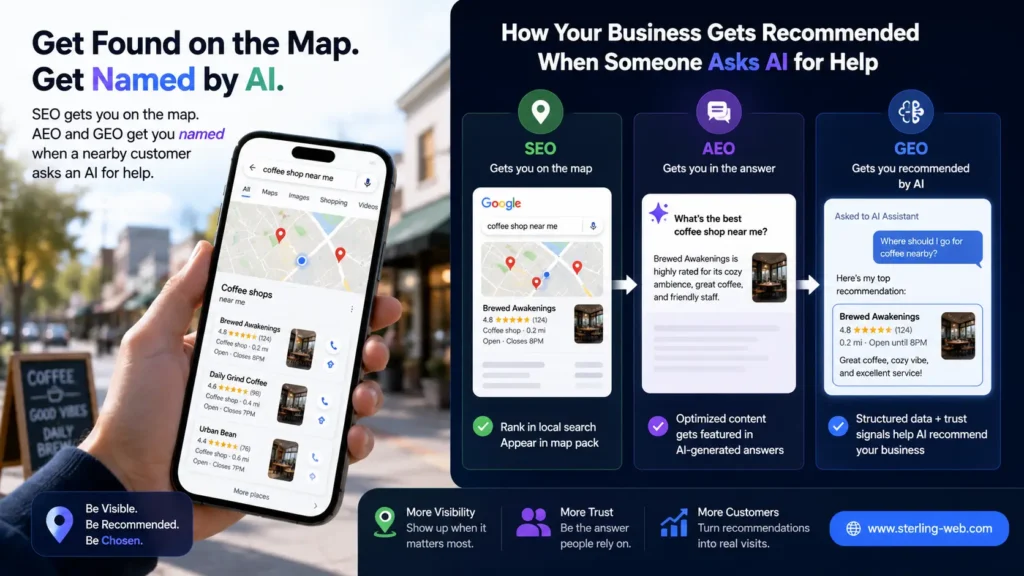
Someone two streets away just asked their phone, “where can I get my watch battery replaced near me?” An AI answered instantly — naming one business. If it wasn’t yours, you didn’t lose to a competitor with a better shop or lower price. You lost to a competitor whose information the AI trusted more. In 2026, that’s how most local discovery now works.
For local businesses — cafés, salons, plumbers, repair shops, studios, clinics — the rules of getting found have changed. This guide explains the three disciplines that now decide whether customers can find you — SEO, AEO, and GEO — why answer and generative optimisation are suddenly essential, and how Core Web Vitals quietly control the whole thing. No jargon for its own sake; just what to fix and why.
Local search just got an AI middleman
At Google I/O in May 2026, Google confirmed its conversational AI Mode had crossed one billion monthly users about a year after launch, and unveiled the biggest search-box redesign in over 25 years. For local businesses, that middleman changes everything:
- The AI answers first. When an AI summary appears, studies have measured click-through drops of roughly 34–46%. The customer often gets your hours, your reviews, and a recommendation without ever visiting a website.
- One question becomes sixteen. Google’s “query fan-out” breaks a single request into around 16 parallel searches, then synthesises one answer. Your business competes to be a trusted source within it.
- Being named is the new ranking. Around 97% of AI Mode responses include at least one citation, and AI Mode and AI Overviews cite the same URLs only about 14% of the time — so there are now several “front pages” you can win.
- Consistency wins. AI engines need to be confident your business is real, open, and where it says it is. Conflicting hours, addresses or phone numbers across the web make AI hesitate — and hesitation means it recommends someone else.
The question is no longer “do I rank for my service near me?” It’s “when an AI helps a nearby customer, is my business the one it confidently names?”
SEO, AEO, GEO — what each one means for a local business
SEO — Search Engine Optimisation
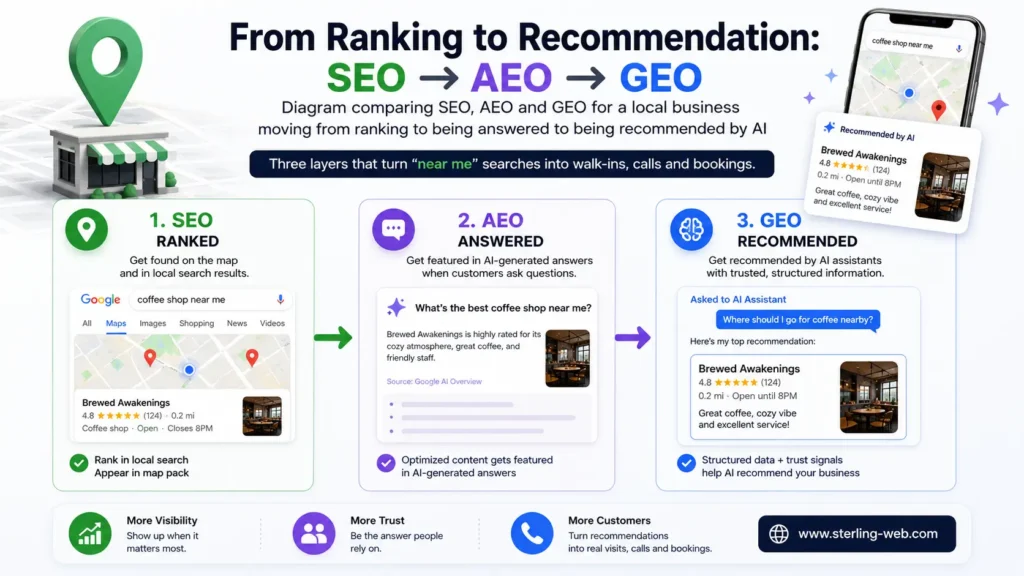
The foundation. SEO is everything that helps Google find, understand and rank your business locally: a fast, crawlable website, service and location pages, an optimised Google Business Profile, consistent name/address/phone (NAP) data, local citations, and reviews. For local businesses, the map pack — those top three local results — is the prize SEO competes for.
AEO — Answer Engine Optimisation
Optimising to be the direct answer to a customer’s question in featured snippets, voice search and AI answer boxes. Customers ask full questions: “what time does the hardware store close?”, “do you take walk-ins?”, “how much does a deep clean cost?”. AEO means structuring clear, accurate answers a machine can lift — making your site the source the answer engine quotes.
GEO — Generative Engine Optimisation
Optimising to be recommended by generative AI — Google AI Overviews and AI Mode, ChatGPT, Gemini, Perplexity. When someone asks “find a reliable plumber near me with good reviews who can come today,” GEO decides whether you’re on the shortlist. It’s driven by trust: genuine reviews, consistent business data, clear service information, and a real online presence.
SEO vs AEO vs GEO — side by side
| Factor | SEO | AEO | GEO |
|---|---|---|---|
| Goal | Rank in results & the map pack | Be the direct answer to a question | Be recommended inside AI answers |
| Surface | Blue links, Google Maps | Snippets, voice search | AI Overviews, AI Mode, ChatGPT, Perplexity |
| Wins on | Local relevance, GBP, NAP, citations | Clear, accurate answers to customer questions | Trust, reviews, consistency, entity recognition |
| Query style | “plumber near me” | “what time does the bakery open?” | “recommend a reliable plumber near me available today” |
| Success metric | Rankings, map visibility, calls | Snippet & voice ownership | AI mentions & recommendations |
| For your business | Found for service & location | Trusted answer to customer questions | Named when AI recommends a local option |
You don’t pick one. You build all three on a fast, healthy website.
Why AEO and GEO matter right now for local businesses
- “Near me” went conversational. Customers no longer type two keywords — they ask full, spoken questions and expect one good answer. The business that is that answer wins the visit; everyone else is invisible.
- The AI decides the shortlist. When AI recommends “the best three options near you,” getting onto that list is the whole game. GEO is how you earn a spot — through reviews, consistency and trust signals.
- Most local competitors are asleep at the wheel. Plenty of local businesses still have inconsistent listings, no structured data, and a slow site. That’s your opening to become the obvious AI pick in your area — before they catch up.
An honest, balanced point: Google’s May 2026 guidance states that from its own perspective, “AEO” and “GEO” are still SEO — its AI features run on the same ranking and quality systems, and no special markup is required just to appear. That’s true for Google. But it doesn’t lower the value of the work. Structured data still earns rich results and helps AI read your business correctly, and AEO/GEO are simply how you make a local site winnable across every AI surface — including ChatGPT and Perplexity, which Google doesn’t control. At SterlingWeb, we treat them as one connected system rather than competing buzzwords.
Core Web Vitals: the gatekeeper between you and the customer
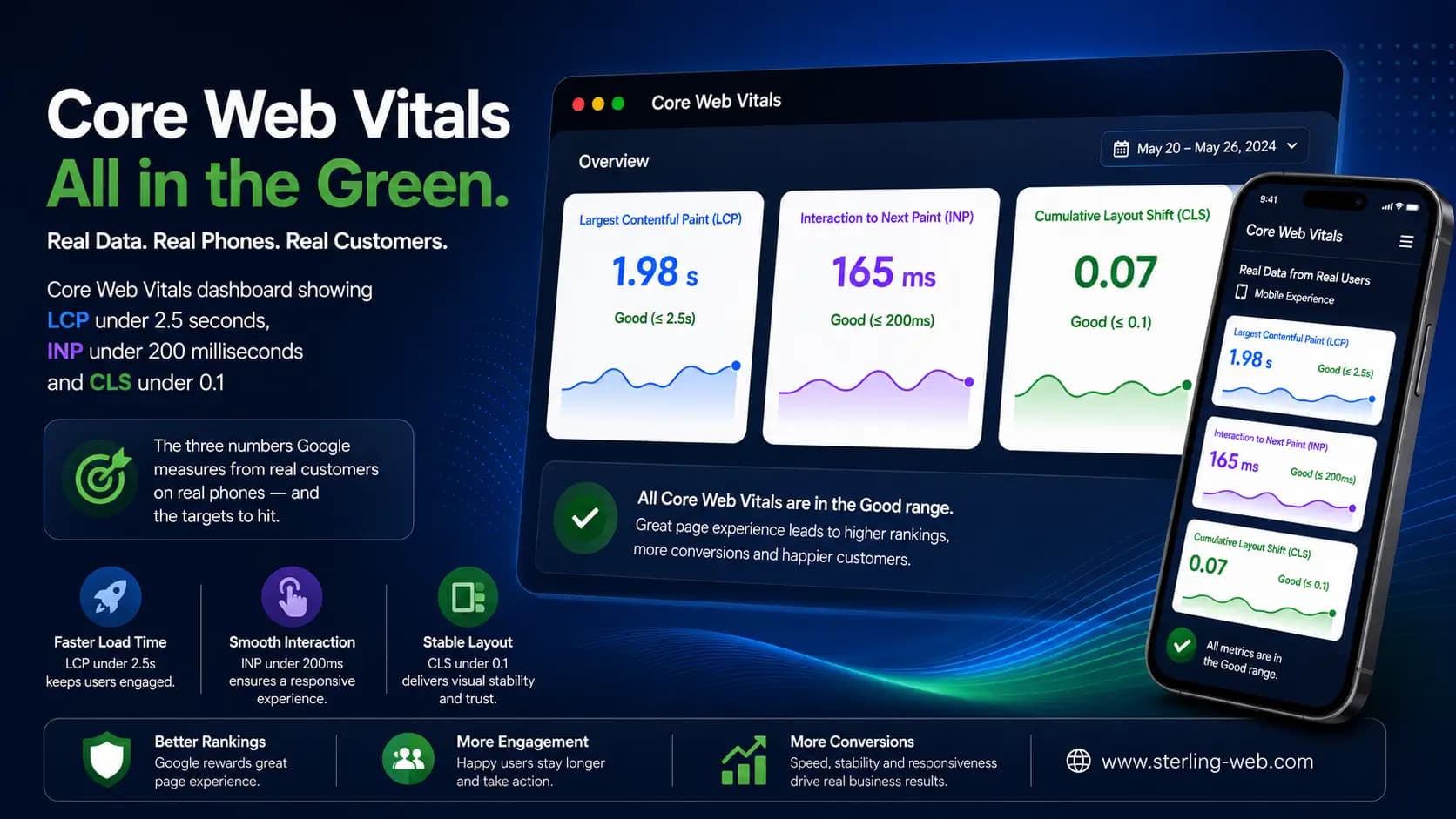
None of this works if your website is slow. Before an AI engine cites you — and before a customer with three options bothers to wait — your page has to load fast and stay stable. Google’s Core Web Vitals measure that real-world experience, and after the March 2026 core update they carry more ranking weight than ever.
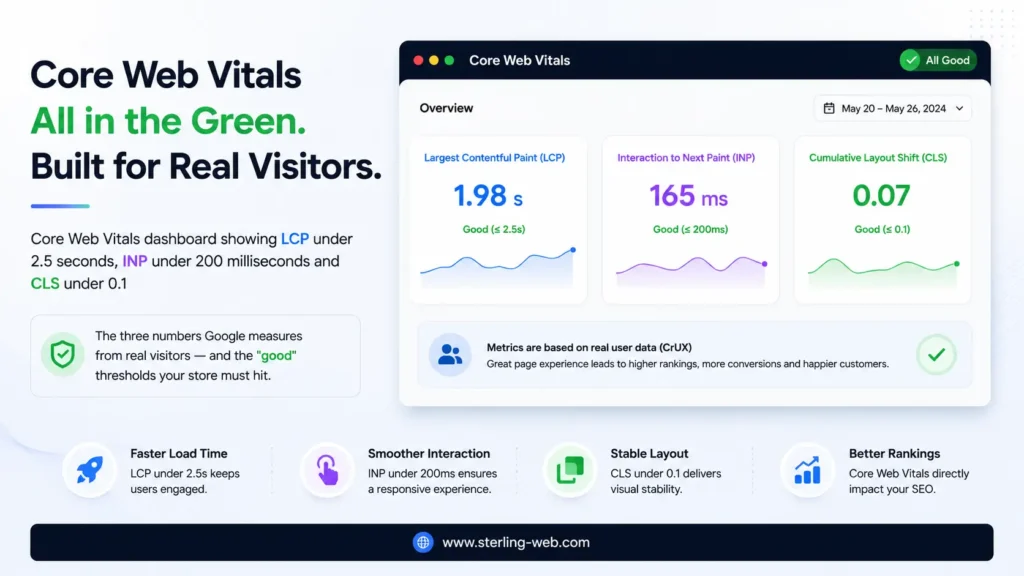
- LCP (Largest Contentful Paint) — how fast your main content loads. Good: under 2.5 seconds. Big, unoptimised photos of your premises or products are the usual cause.
- INP (Interaction to Next Paint) — how fast the page responds when a customer taps “Call”, “Directions” or a booking form. Good: under 200 milliseconds. It replaced FID in March 2024 and is the most-failed metric (around 43% of sites), usually from heavy scripts and plugins.
- CLS (Cumulative Layout Shift) — how much the layout jumps as it loads. Good: under 0.1. A “Call Now” button that shifts as an image loads causes mis-taps and lost customers.
Google measures these at the 75th percentile of real users — your slowest realistic customer on a mid-range phone with a patchy signal, not you on fast wi-fi. The link to revenue is direct: every second of delay raises bounce, and a customer comparing options simply taps the next result. For most local sites, the biggest wins are compressing and right-sizing images (LCP), trimming or deferring plugin scripts (INP), and reserving space for buttons and banners (CLS).
How AI search changes the game — real local scenarios
- The urgent customer asks: “locksmith near me open now.” Your Google Business Profile, accurate hours and local relevance decide if you’re surfaced. That’s SEO — plus a site fast enough to load before they call someone else.
- The planner asks Gemini: “best brunch spot near me with outdoor seating and good reviews.” Your reviews, accurate details and clear service info decide if you make the shortlist. That’s GEO.
- The question-asker says: “do dry cleaners near me do same-day service?” Your clearly structured service FAQ becomes the cited answer, carrying your name with it. That’s AEO.
The connective tissue is LocalBusiness structured data (name, address, hours, services, geo-coordinates, reviews) so engines read you correctly, plus rock-solid consistency across your website, Google Business Profile, and every directory. When your facts match everywhere, AI trusts you. When they conflict, it picks the competitor it’s more sure about.
Your local business AI-search readiness checklist
- Claim and fully optimise your Google Business Profile — categories, services, hours, photos, posts.
- Make your NAP (name, address, phone) identical across your site and every directory and citation.
- Add LocalBusiness schema with address, opening hours, services and geo-coordinates.
- Build clear service and location pages, plus FAQ blocks answering one customer question per section.
- Actively collect genuine reviews and respond to them — reviews are a top AI trust signal.
- Fix Core Web Vitals: compress images (LCP), defer scripts (INP), reserve space for buttons (CLS).
Frequently asked questions
Is local SEO still relevant with AI search?
Yes — more than ever. AI engines pull from the same local signals SEO optimises: your Google Business Profile, consistent NAP data, reviews and local relevance. Strong local SEO is the foundation that makes AEO and GEO visibility possible.
How does my local business get recommended by AI?
By being a trustworthy, consistent source: an optimised Google Business Profile, identical business details everywhere, genuine reviews, clear service information with structured data, and a fast website. AI engines recommend businesses they can confidently verify and that customers rate well.
Why does NAP consistency matter so much?
NAP stands for Name, Address, Phone. When these match across your website, Google Business Profile and directories, search and AI engines trust your business is real and accurate. Conflicting details create doubt, and AI tends to recommend a competitor it’s more certain about.
How do Core Web Vitals affect local customers?
Core Web Vitals measure how fast (LCP), responsive (INP) and stable (CLS) your site feels to real visitors on real phones. A slow or jumpy site increases bounce, loses calls and bookings, hurts rankings, and can stop AI engines from citing you. Hitting the “good” thresholds protects both visibility and customers.
Become the local business AI recommends
In the AI era, the businesses that grow are fast, consistent, and trusted enough that AI engines name them to nearby customers. That’s exactly what SterlingWeb builds — technical SEO, AEO, GEO, schema, and Core Web Vitals, tuned for local businesses.