

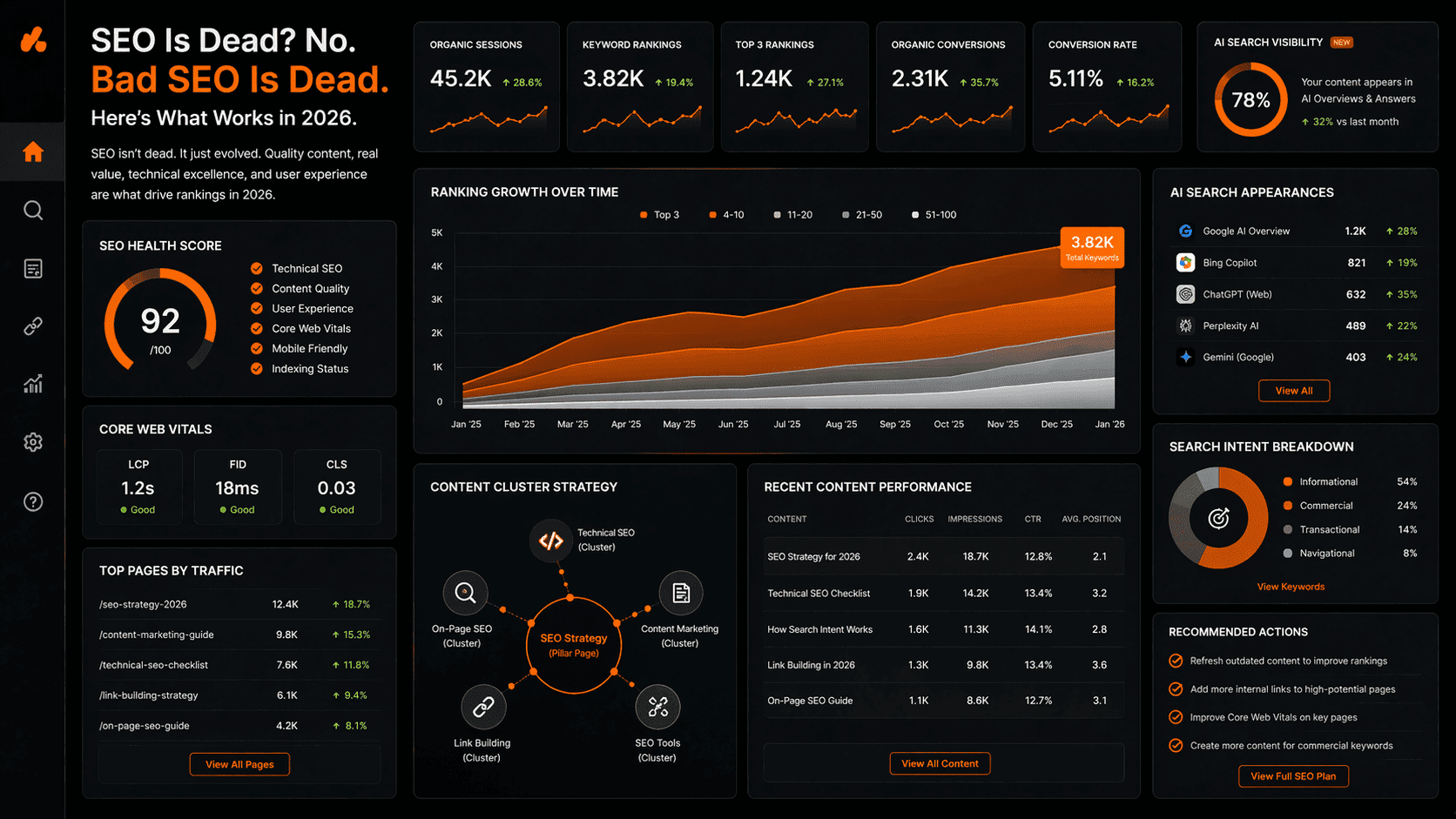
Is SEO Dead in 2026? The Truth About Modern SEO, AI Search, and What Actually Drives Organic Growth
Every year, someone declares that SEO is dead.
Every major Google update, every new AI tool, every algorithm change, and every shift in search behavior sparks the same headline:
“SEO is over.”
Yet businesses that invest in strategic SEO continue to generate millions of visitors, qualified leads, and long-term revenue through organic search.
So, is SEO really dead?
Absolutely not.
What has died is outdated SEO—the kind built around shortcuts, keyword stuffing, mass-produced content, and manipulative link-building tactics. Modern SEO is more sophisticated than ever, combining technical excellence, user experience, high-quality content, and AI readiness.
At Sterlingweb Growth Labs, we help businesses succeed in this new era by combining Technical SEO, Answer Engine Optimization (AEO), Generative Engine Optimization (GEO), and AI-first content strategies to improve visibility across Google and AI-powered search platforms.
Here’s what SEO really looks like in 2026.
What Actually Died: Outdated SEO Tactics
Search engines have become dramatically better at understanding content quality, user intent, and website authority.
The following tactics no longer deliver sustainable results:
- Keyword stuffing
- Publishing hundreds of low-quality blog posts
- Buying spammy backlinks
- Creating pages solely for search engines
- Duplicate or AI-generated content without human expertise
- Thin content targeting every keyword variation
Google’s algorithms—and increasingly AI-powered search systems—reward websites that provide genuine value to users.
Shortcuts may produce temporary gains, but they rarely survive algorithm updates.
Search Intent Is More Important Than Keywords
Keywords still matter, but they are no longer the primary ranking factor.
Today’s search engines evaluate whether your content satisfies the intent behind a query.
When someone searches:
- “Best Shopify development agency”
- “How to improve Core Web Vitals”
- “WooCommerce vs Shopify migration”
they expect different types of answers.
Understanding search intent means identifying:
- What the user wants to achieve
- Whether they’re researching or ready to buy
- Which questions remain unanswered
- What information helps them make a decision
Content aligned with user intent performs better in both rankings and conversions.
Helpful, Authoritative Content Wins
Publishing more content doesn’t guarantee more traffic.
Publishing better content does.
High-performing content should:
- Solve real problems
- Provide actionable insights
- Include original expertise
- Be easy to read and navigate
- Answer related questions comprehensively
- Include visuals, examples, and supporting resources
Google’s Helpful Content System favors websites that demonstrate expertise and provide meaningful value rather than simply targeting keywords.
The goal is no longer to write for search engines—it’s to create the best possible answer for your audience.
Topical Authority Beats Random Blogging
Many websites still publish unrelated articles simply to increase page count.
This strategy rarely works today.
Modern SEO rewards topical authority.
Instead of creating random content, build comprehensive content clusters around your expertise.
For example, if your business offers Shopify development, create in-depth resources covering:
- Shopify store development
- Shopify theme customization
- Shopify app development
- Shopify speed optimization
- Shopify SEO
- Shopify migrations
- Conversion rate optimization
- Shopify Plus
- Headless Shopify
Interlink these articles strategically to help users and search engines understand your expertise.
When your website becomes a trusted resource on a specific subject, rankings improve naturally.
Technical SEO Still Matters
Even the best content struggles if your website performs poorly.
Technical SEO ensures search engines can crawl, index, and understand your website efficiently.
Focus on the fundamentals:
- Fast page loading
- Core Web Vitals optimization
- Mobile-first design
- Secure HTTPS implementation
- Clean URL structures
- XML sitemaps
- Proper schema markup
- Internal linking
- Canonical tags
- Crawl error resolution
Technical SEO isn’t about chasing every minor optimization—it’s about building a strong foundation for long-term visibility.
SEO Without Conversion Optimization Is Incomplete
Ranking first on Google means little if visitors leave without taking action.
Modern SEO must work alongside Conversion Rate Optimization (CRO).
Successful websites combine search visibility with conversion-focused design by using:
- Clear value propositions
- Strong calls-to-action
- Trust signals
- Customer testimonials
- Case studies
- Mobile-friendly layouts
- Fast loading pages
- Simple contact forms
- Optimized landing pages
SEO brings potential customers to your website.
Conversion optimization turns that traffic into revenue.
AI Changed Search—It Didn’t Replace SEO
The rise of AI platforms like ChatGPT, Gemini, Claude, Copilot, and Perplexity has transformed how people discover information.
Users increasingly ask complete questions rather than typing short keyword phrases.
This evolution hasn’t eliminated SEO—it has expanded it.
Businesses now need to optimize for both traditional search engines and AI-powered answer engines.
This includes:
- Answer Engine Optimization (AEO)
- Generative Engine Optimization (GEO)
- Structured data implementation
- Clear content hierarchy
- FAQ sections
- Entity optimization
- Semantic relevance
- Trustworthy sources
Content that is well-organized, authoritative, and easy for AI systems to interpret has a greater chance of appearing in AI-generated responses.
Original Expertise Is More Valuable Than Ever
AI can generate content quickly.
However, AI-generated content without genuine expertise rarely creates long-term authority.
Successful businesses publish content based on:
- Real project experience
- Original research
- Case studies
- Industry knowledge
- Practical recommendations
- Proven results
Search engines increasingly reward content that demonstrates Experience, Expertise, Authoritativeness, and Trustworthiness (E-E-A-T).
Sharing insights from actual client work builds credibility with both users and search engines.
Backlinks Still Matter—Quality Over Quantity
Backlinks remain an important ranking factor, but quality has become far more important than volume.
One backlink from a respected industry publication can provide more value than dozens of links from low-quality websites.
Effective link-building strategies include:
- Publishing original research
- Creating valuable resources
- Guest posting on authoritative sites
- Digital PR campaigns
- Industry partnerships
- Earning editorial mentions
Natural, relevant backlinks strengthen domain authority and improve long-term rankings.
Consistency Drives Long-Term Success
SEO isn’t a one-time project.
It requires continuous improvement.
Successful businesses consistently:
- Publish valuable content
- Update existing pages
- Improve internal linking
- Monitor keyword performance
- Optimize user experience
- Track technical issues
- Analyze search trends
Organic growth compounds over time when websites continue improving instead of remaining static.
The Future of SEO: SEO + AEO + GEO
The future of search extends beyond Google.
Customers now discover businesses through:
- Google Search
- Google Discover
- ChatGPT
- Google Gemini
- Microsoft Copilot
- Claude
- Perplexity AI
- Voice assistants
Businesses that optimize only for traditional search risk missing opportunities in AI-driven discovery.
At Sterlingweb Growth Labs, we help organizations prepare for this future through:
- Technical SEO
- Answer Engine Optimization (AEO)
- Generative Engine Optimization (GEO)
- AI-ready content architecture
- Structured data implementation
- Core Web Vitals optimization
- WordPress and Shopify performance optimization
The goal isn’t simply to rank—it is to become the trusted answer wherever customers search.
Why Businesses Choose Sterlingweb Growth Labs
We believe modern SEO is about building digital authority, not chasing algorithms.
Our services include:
- Technical SEO Audits
- Enterprise SEO Strategy
- WordPress SEO
- Shopify SEO
- Answer Engine Optimization (AEO)
- Generative Engine Optimization (GEO)
- AI SEO
- Core Web Vitals Optimization
- Content Strategy
- Schema Markup
- Website Speed Optimization
- SEO Migration Support
- Local SEO
- Ongoing Performance Monitoring
Our approach combines strategy, technical expertise, and measurable business outcomes to help clients build sustainable organic growth.
Final Thoughts
SEO isn’t dead.
It has simply evolved.
The era of shortcuts, keyword stuffing, and low-quality content is over. Today’s SEO rewards businesses that invest in technical excellence, helpful content, strong user experiences, and genuine expertise.
Success in 2026 comes from understanding your audience, creating valuable content, optimizing for both search engines and AI platforms, and continuously improving your website based on real data.
The businesses that embrace this evolution will continue attracting qualified traffic, building authority, and generating revenue long after outdated tactics disappear.
If your SEO strategy isn’t delivering results, don’t assume SEO has stopped working.
Instead, ask whether your approach has evolved with the way people search today.
Because when done correctly, SEO remains one of the highest-return digital marketing investments available—and it will continue to be a powerful growth channel for years to come.
Frequently Asked Questions
Is SEO still worth investing in during 2026?
Yes. SEO continues to deliver long-term organic traffic, qualified leads, and sustainable business growth when combined with technical optimization, valuable content, and user-focused strategies.
Has AI replaced SEO?
No. AI has changed how people search, but it has expanded SEO rather than replacing it. Businesses now need to optimize for traditional search engines and AI-powered answer platforms through AEO and GEO.
What matters most for SEO today?
Search intent, high-quality content, technical SEO, Core Web Vitals, topical authority, structured data, and a strong user experience are among the most important ranking factors.
Are backlinks still important?
Yes, but quality is far more valuable than quantity. Relevant, authoritative backlinks remain an important signal of trust and credibility.
How can businesses prepare for the future of search?
Invest in technical SEO, publish expert-led content, optimize for AI search with AEO and GEO strategies, improve website performance, and focus on creating genuinely helpful experiences for users across every search platform.