

Search is changing faster than ever. For years, Search Engine Optimization (SEO) has been the primary strategy businesses use to improve their visibility on search engines. Today, however, users are no longer searching only through traditional search engines. They are also asking questions through AI-powered platforms and answer engines.
This shift has introduced new approaches to digital visibility, including Answer Engine Optimization (AEO) and Generative Engine Optimization (GEO).
While SEO, AEO, and GEO share the common goal of helping businesses become more discoverable online, they focus on different types of search experiences. Understanding the difference between GEO vs SEO vs AEO can help businesses build a stronger strategy for the future of search.
What Is SEO?
SEO (Search Engine Optimization) is the process of improving a website’s visibility in traditional search engine results.
The goal of SEO is to help web pages rank higher when users search for relevant keywords and topics on platforms such as Google and other search engines.
SEO typically includes several important areas:
- Keyword research and content optimization
- On-page SEO
- Technical SEO
- Website speed and performance
- Mobile optimization
- Internal linking
- Backlink building
- Structured data and schema markup
- User experience optimization
For example, if someone searches for “Shopify development services“, a business offering Shopify development may optimize its website and content to rank for that search query.
Traditional SEO is still essential because search engines remain a major source of website traffic, leads, and customers.
However, search behavior is evolving. Users increasingly want quick answers instead of clicking through multiple web pages.
This is where AEO and GEO become important.
What Is AEO?
AEO (Answer Engine Optimization) focuses on optimizing content so that it can be easily understood, selected, and presented as a direct answer to a user’s question.
Instead of focusing only on ranking a webpage, AEO focuses on helping content appear in answer-based search experiences.
Answer engines may provide users with:
- Direct answers
- Featured snippets
- Voice search responses
- Question-and-answer results
- AI-generated summaries
AEO requires businesses to create clear, well-structured, and authoritative content.
For example, instead of creating content only around a keyword such as:
“What is technical SEO?”
An AEO-focused page would provide a direct and concise answer near the beginning:
Technical SEO is the process of optimizing a website’s technical structure, performance, and accessibility so search engines can effectively crawl, index, and understand its content.
The content can then provide more detailed explanations.
Important AEO Strategies
Some important elements of AEO include:
- Answering questions clearly and directly
- Using question-based headings
- Creating FAQ sections
- Writing concise definitions
- Using structured content
- Adding relevant schema markup
- Demonstrating expertise and credibility
- Organizing information logically
AEO is particularly important as users increasingly search using natural-language questions.
Instead of typing only:
SEO services
Users may ask:
“What is the best SEO strategy for a growing business?”
Content that clearly answers the question has a better opportunity to be useful across answer-focused search experiences.
What Is GEO?
GEO (Generative Engine Optimization) is the practice of improving content so it can be understood, referenced, and potentially used by AI-powered generative search systems.
Generative AI platforms do not always work exactly like traditional search engines. Instead of simply displaying a list of web pages, they may analyze information from multiple sources and generate a summarized response.
GEO focuses on helping brands improve their visibility within these AI-generated experiences.
Generative search platforms may include AI-powered search assistants and conversational search experiences.
The goal is not simply to rank at the top of a list of links. Instead, the goal is to increase the likelihood that a brand’s expertise, products, services, or information is accurately represented when AI systems generate relevant answers.
Important GEO Strategies
A strong GEO strategy may include:
- Publishing original and valuable content
- Demonstrating subject matter expertise
- Building a consistent brand presence
- Creating clearly structured information
- Supporting claims with trustworthy sources
- Using entities and relevant contextual information
- Maintaining accurate website content
- Implementing appropriate structured data
- Building topical authority
For example, a company that consistently publishes useful information about Shopify development, eCommerce optimization, and technical SEO may have a stronger overall information footprint than a website with only a few generic service pages.
GEO is becoming increasingly important because AI-powered discovery is changing how people find information and evaluate brands.
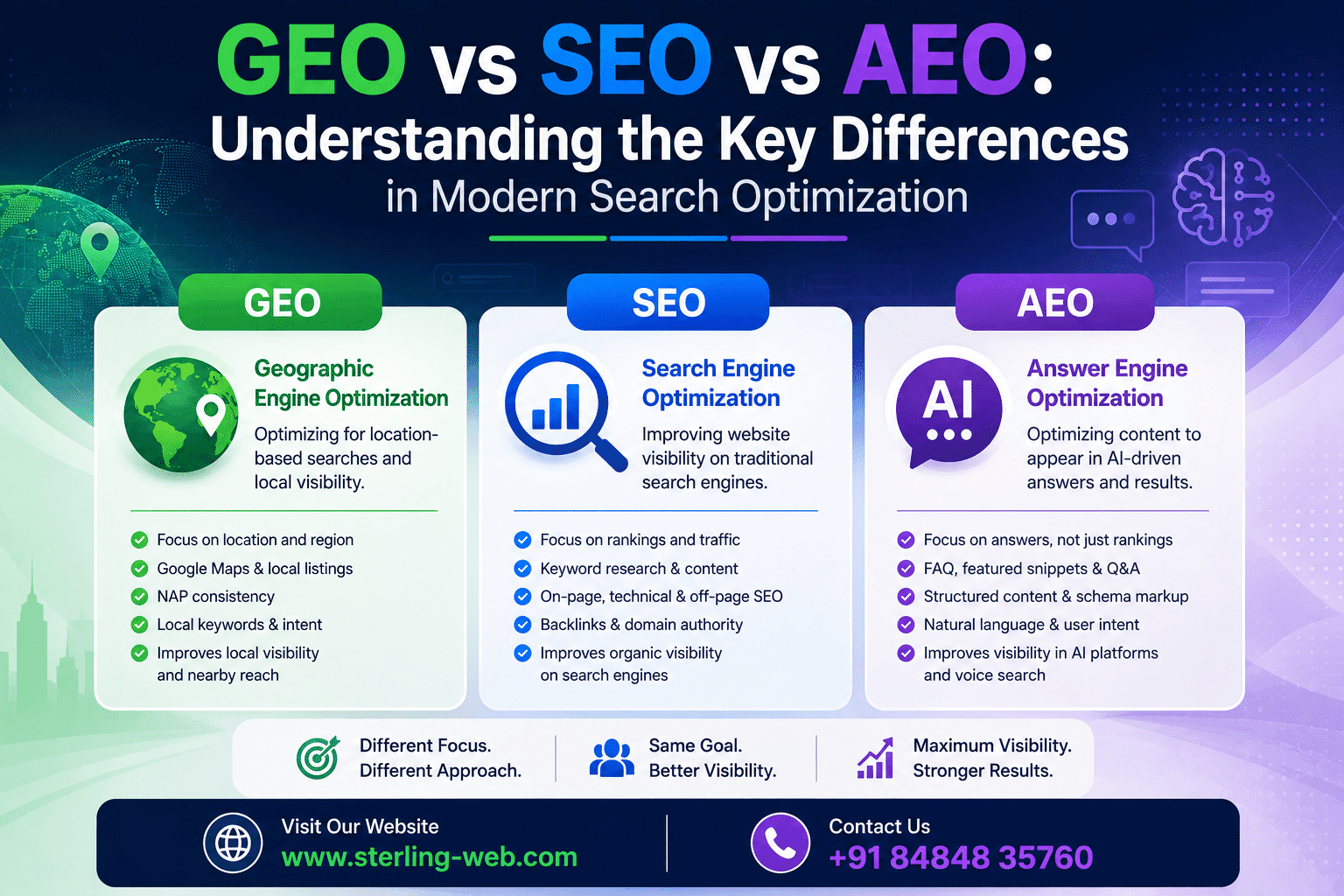
GEO vs SEO vs AEO: The Main Differences
Although these three strategies are connected, their primary focus is different.
| Strategy | Primary Focus | Main Goal |
|---|---|---|
| SEO | Traditional search engines | Improve rankings and organic visibility |
| AEO | Direct answers and answer engines | Help content become a clear answer |
| GEO | AI-powered generative search | Improve visibility in AI-generated responses |
SEO Focuses on Rankings
SEO primarily focuses on helping pages perform well in search results.
It considers factors such as relevance, technical accessibility, content quality, website experience, and authority.
The desired outcome is typically increased organic visibility and qualified website traffic.
AEO Focuses on Answers
AEO focuses on providing information in a format that directly answers user questions.
The content should be easy to understand, well organized, and highly relevant to the user’s intent.
The desired outcome is greater visibility in answer-focused search experiences.
GEO Focuses on AI Visibility
GEO focuses on how information is discovered and represented in generative AI environments.
It requires businesses to think beyond individual keywords and focus on broader topics, expertise, entities, context, and information quality.
The desired outcome is stronger brand visibility across AI-generated search and discovery experiences.
Why Businesses Need All Three
One of the biggest mistakes businesses can make is assuming that GEO, SEO, and AEO are completely separate strategies.
In reality, they often work together.
A technically strong website provides a better foundation for SEO.
Well-structured and helpful content can support both SEO and AEO.
Authoritative, original, and context-rich content can strengthen a brand’s presence for GEO.
For this reason, businesses should think about modern search optimization as an integrated strategy.
A strong approach could include:
1. Build a Solid Technical SEO Foundation
Make sure search engines can effectively access and understand your website.
Focus on:
- Website speed
- Mobile usability
- Crawlability
- Indexability
- Internal linking
- Structured data
2. Create Content Around Real User Questions
Research what your audience actually wants to know.
Create content that answers questions clearly instead of simply repeating keywords.
Use headings, lists, definitions, examples, and FAQs to improve readability.
3. Build Topical Authority
Instead of publishing random blog posts, create comprehensive content around the subjects most relevant to your business.
For example, an eCommerce agency could build content clusters around:
- Shopify development
- Shopify SEO
- Website migrations
- eCommerce performance
- Technical SEO
- AI search optimization
This helps create a stronger and more connected knowledge base.
4. Make Your Brand Information Consistent
Your business information, services, expertise, and brand positioning should be clear and consistent across your website and relevant online platforms.
Consistency makes it easier for users and systems to understand what your business does and what topics it is associated with.
The Future of Search Optimization
The future of search is not about replacing SEO with AEO or GEO.
Instead, search optimization is expanding.
Traditional search engines will continue to play an important role. At the same time, answer engines and AI-powered platforms are creating new ways for users to discover information.
Businesses that focus only on traditional rankings may miss opportunities to appear in emerging search experiences.
The future will require a broader approach that considers:
- Search engine rankings
- Direct answers
- Conversational queries
- AI-generated results
- Brand authority
- Content quality
- User intent
- Entity and topical relevance
The businesses that adapt early will be better positioned to maintain visibility as search technology continues to evolve.
Conclusion
GEO vs SEO vs AEO is not a competition between three completely separate strategies. Each approach serves a different purpose in the modern search ecosystem.
SEO helps businesses improve visibility in traditional search results. AEO helps content provide clear and direct answers. GEO focuses on improving visibility in AI-powered and generative search experiences.
The strongest digital strategy combines all three.
By investing in technical SEO, high-quality content, clear answers, topical authority, structured information, and a strong brand presence, businesses can prepare for both today’s search landscape and the future of AI-powered discovery.
Different technologies may change how people search, but the foundation remains the same: create valuable, accurate, helpful content that genuinely answers what people want to know.