

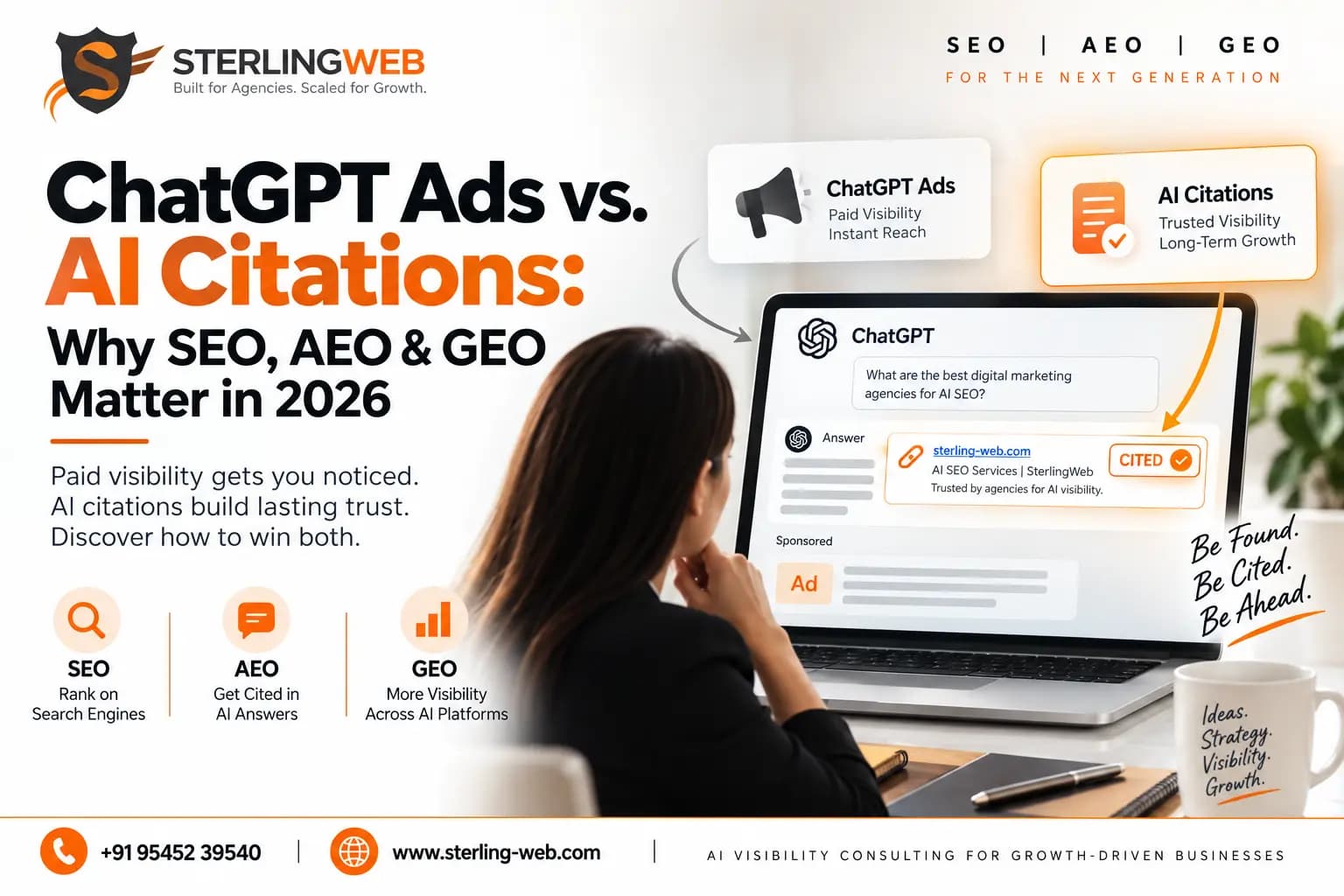
ChatGPT Ads are sponsored placements shown below ChatGPT’s answers to logged-in Free and Go users, sold on a CPM or CPC basis through OpenAI’s Ads Manager. They are now live in more than 40 countries, including India, the US, the UK, Europe and Australia. But paid placement is only half the opportunity. The other half — often the more profitable half — is being cited inside the answer itself, which no amount of ad spend can buy. This guide explains both, and shows exactly how SterlingWeb engineers brands into ChatGPT’s answers.
What Are ChatGPT Ads?
ChatGPT Ads are OpenAI’s advertising product inside ChatGPT. OpenAI began testing them in the United States in early 2026 and expanded rapidly through the year — first to Canada, Australia and New Zealand, then the UK, Japan, South Korea, Mexico and Brazil, then 31 European markets, and on to India, the Middle East and North Africa.
By OpenAI’s own reporting in August 2026, ChatGPT Ads passed a $1 billion annualised revenue run rate in under 200 days, with tens of thousands of advertisers on the platform. For context on the audience size, OpenAI describes an advertising-supported free tier that helps keep ChatGPT available to more than a billion weekly active users. This is no longer an experiment. It is a mainstream channel.
Where ChatGPT Ads Appear
Ads sit below the answer, clearly labelled and visually separated from ChatGPT’s response. OpenAI has been explicit that advertising does not influence the content of the answer itself — a principle it calls answer independence. The ad system uses the context of the current conversation to decide what to show, and depending on the country and the user’s settings, may also draw on broader ChatGPT usage context.
Practically, that means the targeting signal is intent expressed in natural language rather than a keyword typed into a search box. Someone describing a renovation budget, a software shortlist or a shipping constraint is giving far richer targeting context than “best CRM software”.
Who Actually Sees ChatGPT Ads
- Logged-in users on the Free and Go plans see ads.
- Plus, Pro, Business, Enterprise and Education accounts are ad-free.
- Users under 18 — self-declared or predicted by OpenAI — are not shown ads.
- Users can control ad personalisation, and advertisers never receive access to private conversations.
This creates an important strategic gap that most agencies are ignoring: your highest-value B2B buyers are frequently on paid, ad-free tiers. A procurement lead, an agency director or a CTO evaluating vendors is very often a Plus, Business or Enterprise user. You cannot reach them with a ChatGPT ad at all. You can only reach them by being cited in the answer.
How You Buy ChatGPT Ads
OpenAI opened a self-serve Ads Manager during 2026, which brought small and medium businesses onto a platform that had started as a managed-sales and agency-partner model. Advertisers register, add payment details, set budgets, bids and pacing, upload creative, launch campaigns and review performance in the portal. Larger advertisers can still buy through the OpenAI Ads Solutions team, agency partners or one of 50+ technology and measurement partners.
| Capability | What it means for you |
|---|---|
| CPM bidding | The original buying model — pay per thousand impressions. Useful for awareness and category entry. |
| CPC bidding | Pay per click, so spend aligns with action. OpenAI reports CPC and outcome-optimised bidding now account for most campaigns. |
| Outcome-optimised bidding | Bid toward a conversion event rather than a click. |
| Pixel & Conversions API | The measurement foundation. Without these, you are flying blind on ROAS. |
| Product feeds | Ecommerce catalogue ingestion — relevant for Shopify and WooCommerce stores. |
| Geographic & platform targeting | Restrict delivery by market and device context. |
| Custom audiences | Reach segments most relevant to your business. |
OpenAI has published early performance examples including an ecommerce advertiser reaching a 3x return on ad spend across a 28-day window, and a technology partner reporting that more than 80% of ad-driven ChatGPT traffic came from new customers. Treat these as directional, not as a benchmark you should expect to hit.
Which Countries Have ChatGPT Ads
As of the most recent OpenAI announcement, ChatGPT Ads are available in over 40 countries through the Ads Solutions team and partners, with self-service Ads Manager access covering the US, Canada, Australia, New Zealand, the UK, Japan, South Korea, Mexico, Brazil, 31 European markets, India, the Middle East and North Africa. India is one of ChatGPT’s largest and most active markets, and ads there run on the Free tier and the ₹399/month Go plan.
Availability moves fast. Always confirm current market coverage in OpenAI’s Ads Manager availability documentation before building a media plan around it.
Why ChatGPT Ads Change the Rules for SEO, AEO and GEO
Google separated the funnel across many sessions. Someone searched, clicked, compared, searched again, and eventually converted. ChatGPT compresses discovery, consideration and decision into a single conversation. The user states a goal, describes constraints, asks for options, challenges the recommendation, and asks what to do next — all in one thread.
That compression has three consequences that every business owner should sit with:
- The shortlist forms before you get a chance to bid. By the time an ad appears, ChatGPT has already named three or four brands in the answer. If you were not one of them, the ad is fighting uphill against a recommendation the user already trusts.
- Zero-click is now the default, not the exception. Your brand can influence a purchase without a single session appearing in Google Analytics. Traditional attribution under-reports AI-driven demand badly.
- Ad spend rents visibility. Citations own it. Pause the campaign and the placement disappears the same day. A well-built entity and content foundation keeps producing citations for years.
Paid Placement vs Being Cited: The Two Ways to Show Up in ChatGPT
These are genuinely different mechanisms with different levers. Confusing them is the single most expensive mistake we see.
| ChatGPT Ads | ChatGPT Citations (AEO/GEO) | |
|---|---|---|
| Position | Below the answer, labelled sponsored | Inside the answer, as a named brand or linked source |
| Audience reach | Free and Go users only | Every user, including Plus, Pro, Business and Enterprise |
| Cost model | CPM / CPC — ongoing spend | Fixed investment in assets that compound |
| Speed | Days | Typically 60–120 days for meaningful movement |
| Trust perception | Recognised as advertising | Read as an editorial recommendation |
| Durability | Stops when budget stops | Persists and strengthens over time |
| Who controls it | OpenAI’s auction | Your entity signals, content and earned authority |
The correct answer for most businesses is not “one or the other”. It is citations as the foundation, ads as the accelerant — because an ad clicked by someone who already saw your brand recommended in the answer above it converts at a materially different rate than a cold impression.
How ChatGPT Decides What to Cite
ChatGPT answers from two layers, and the difference between them decides whether you get a passing mention or a clickable citation.
Layer One: Training Data (Parametric Knowledge)
This is what the model absorbed before its cutoff. Published analyses suggest a majority of ChatGPT responses are answered from this layer alone without a live web lookup. When ChatGPT answers from training, it may name your brand, but it rarely links to you. Winning here is a long game built on sustained press coverage, encyclopaedic presence and consistent brand description across the web.
Layer Two: Live Retrieval (RAG)
When a query has commercial or research intent — words like best, compare, reviews, pricing, alternatives, or a year — ChatGPT is far more likely to run a live search. It decomposes the question into sub-queries, retrieves pages, and synthesises an answer from a small handful of sources. This is the layer that produces clickable citations, and it is the layer you can influence this quarter.
What the 2026 Citation Studies Show
Several large-scale independent analyses published across 2025–2026 converge on a consistent picture. Figures vary by methodology, so treat them as directional patterns rather than precise constants:
- Retrieval is brutally selective. Studies of large prompt samples find ChatGPT cites only around 15% of the pages it actually retrieves. Being retrieved is not the same as being cited.
- Community and reference platforms dominate. An Ahrefs analysis of 9.6 million ChatGPT queries found Reddit captured close to a third of citations and Wikipedia around 15%. A Semrush study across roughly 230,000 prompts placed the top five as Reddit, Wikipedia, Medium, Forbes and LinkedIn.
- Position on the page matters enormously. Analysis of over a million ChatGPT answers found roughly 44% of citations are pulled from the first third of a page. Burying your answer below 800 words of preamble is a self-inflicted wound.
- Brand-owned content is structurally under-represented compared to earned media. Your own website alone is not enough.
- Freshness beats raw authority on commercial queries. A competitor’s “Best X in 2026” guide updated this month can outrank your higher-DA page from last year.
- Cross-platform presence beats single-domain optimisation. A brand that appears consistently across directories, review platforms and community discussions creates a denser trust signal than an isolated, perfectly optimised website.
The conclusion is uncomfortable for traditional SEO teams: you cannot win ChatGPT citations from your own website alone. You need entity clarity, answer-first structure, retrievability, and earned presence in the places ChatGPT actually pulls from.
SEO vs AEO vs GEO: What Each One Actually Does
These three terms get used interchangeably by agencies that do not understand them. Here is the honest distinction.
SEO — Search Engine Optimisation
Earning rankings and clicks in classic search results. Crawlability, indexation, Core Web Vitals, internal linking, backlinks, keyword coverage. Still foundational — ChatGPT’s live retrieval leans on a search index, so a site that search engines cannot crawl or trust will not be retrieved either.
AEO — Answer Engine Optimisation
Structuring content so a machine can lift a clean, correct, self-contained answer out of it. Question-shaped headings, direct answers in the first 40–60 words of a section, definition blocks, comparison tables, FAQ and HowTo schema, unambiguous facts with dates and numbers.
GEO — Generative Engine Optimisation
Making your brand as an entity legible and trusted to generative systems, so you are named and recommended even when no link is shown. This is entity work: consistent naming, Organisation and Person schema with sameAs, knowledge-base and directory presence, review platform coverage, founder visibility, and earned mentions in the sources these models trust.
The short version: SEO gets you found. AEO gets you quoted. GEO gets you recommended. ChatGPT Ads get you a paid slot underneath whoever won the first three.
How SterlingWeb Helps Businesses Get Cited on ChatGPT
SterlingWeb is a full-service digital agency based in Nashik, India, working with clients across India, the US, the UK, Europe and Australia. We run technical SEO, AEO and GEO programmes alongside Shopify and WordPress development — which matters, because most AI visibility work eventually requires someone who can actually ship code, not just write a recommendation deck.
Here is the six-phase framework we use to move a brand from invisible to cited.
Phase 1 — AI Visibility Audit and Citation Baseline
We start by measuring what is actually happening, not what you assume is happening. That means:
- Building a prompt set of 50–150 real buyer questions across the funnel — problem-aware, solution-aware, comparison, pricing, local and objection queries.
- Running that set across ChatGPT, Perplexity, Gemini and Google AI Overviews and recording brand mention rate, citation rate, sentiment, and which competitors and third-party sources are winning each answer.
- Auditing what ChatGPT currently believes about your brand — because incorrect or outdated entity facts are surprisingly common and quietly destroy conversion.
- Scoring the site on SEO, AEO and GEO separately, so you can see which of the three is the actual bottleneck.
You end this phase with a number you can hold us to: your baseline citation share on the queries that matter to your revenue.
Phase 2 — Entity Foundation (The GEO Layer)
Generative systems recommend entities they can identify with confidence. We make your brand unambiguous:
- Schema architecture — Organization, LocalBusiness, Product, Service, Person, Article, FAQPage and BreadcrumbList, correctly nested and validated, with a full
sameAsgraph tying every profile back to one canonical entity. - Naming consistency — one legal name, one trading name, identical NAP data everywhere. Inconsistency splits your entity in two and halves your authority.
- Knowledge base and directory presence — Wikidata, Crunchbase, industry directories, and the review platforms in your category (G2, Capterra, Trustpilot, Clutch, Google Business Profile, sector-specific equivalents).
- Founder and expert entities — author profiles with real credentials, bylines and cross-linked identity. E-E-A-T signals matter more, not less, to answer engines.
- International entity clarity — hreflang and geo-targeting done properly. We have seen brands targeting five markets whose entire site was signalling a single country. That alone suppresses visibility in four of them.
Phase 3 — Answer-First Content Architecture (The AEO Layer)
Since roughly 44% of citations come from the first third of a page, we restructure content so the extractable answer is at the top, not the bottom:
- Answer-first blocks — every H2 and H3 opens with a complete, self-contained answer in 40–60 words before any elaboration.
- Question-shaped headings that mirror how people actually phrase things to an AI, not how keyword tools phrase them.
- Extractable formats — comparison tables, specification lists, definition blocks, step sequences and pricing tables. Machines lift structured chunks far more reliably than flowing prose.
- Genuine FAQ depth covering objections, pricing, alternatives, timelines and “is this right for me” questions — with FAQPage schema behind them.
- Statistics, dates and named sources, because content with verifiable specifics gets cited more than content full of adjectives.
- A refresh cadence, since freshness demonstrably beats raw authority on commercial-intent queries.
Phase 4 — Technical Retrievability
If an AI crawler cannot fetch and parse your page cleanly, none of the content work matters. This is where an agency that writes code beats one that writes recommendations:
- Explicit crawler policy for
GPTBot,OAI-SearchBot,PerplexityBot,ClaudeBotandGoogle-Extended— a deliberate decision, documented, not an accident inherited from a theme’s default robots.txt. - Server-rendered content. JavaScript-dependent copy is a common and invisible cause of zero citations.
- Clean semantic HTML, proper heading hierarchy, real tables and lists instead of styled divs.
- Speed and Core Web Vitals, canonical hygiene, XML sitemaps, and IndexNow for fast discovery of updates.
- An
llms.txtfile where appropriate, and clean, stable, descriptive URLs.
SterlingWeb implements these changes directly on WordPress and Shopify. If your site runs on another stack — .NET, custom PHP, headless — we produce a precise, developer-ready specification and work alongside your existing development team. We would rather hand your developers an exact brief than pretend to expertise in a stack we do not ship on daily.
Phase 5 — Earned Media and Community Signals
This is the phase most agencies skip, and it is the one the data says matters most. Since brand-owned content is structurally under-represented in ChatGPT citations while community and editorial sources dominate, we build presence where the model is actually looking:
- Genuine community participation in the subreddits and forums where your buyers ask questions — answering properly, not dropping links. Ham-fisted Reddit promotion gets removed and damages the brand.
- Digital PR and expert commentary aimed at the publications that get cited in your category.
- Review platform strategy — volume, recency and response quality on the platforms ChatGPT pulls into product comparisons.
- Original research and data you own — surveys, benchmarks, price studies. Original data is the most reliably citable asset a brand can produce.
- Founder-led publishing on LinkedIn and Medium, both of which appear in the top-cited source sets.
- Notability groundwork — building the independent secondary coverage that makes an eventual Wikipedia entry viable. We never write our clients’ own Wikipedia pages; that gets reverted and hurts you.
Phase 6 — Measurement, Reporting and Iteration
AI visibility fails as a service when nobody can prove it worked. Our monthly reporting tracks:
- Citation share and mention rate across your tracked prompt set, versus named competitors.
- Sentiment and factual accuracy of how AI systems describe you.
- Referral traffic from
chatgpt.com,perplexity.aiand other AI sources, segmented in GA4. - AI crawler hit rates from server logs — the earliest signal that technical fixes are working.
- Assisted conversions and self-reported attribution (“how did you hear about us?”), because AI-influenced demand is systematically under-counted by last-click models.
- Classic SEO metrics in parallel, since the two reinforce each other.
Should You Run ChatGPT Ads or Invest in Citations? A Budget Framework
An honest answer depends on your model, margin and time horizon. These are the patterns we see:
| Your situation | Recommended split |
|---|---|
| D2C ecommerce, consumer audience, healthy margin, product feed ready | Ads early — your buyers skew toward Free/Go tiers. Run AEO/GEO in parallel to lower long-term CAC. |
| B2B SaaS or services with long sales cycles | Citations first. Your decision-makers are disproportionately on ad-free paid plans. Ads are a poor primary channel here. |
| Local service business | GEO + local entity work first. Ads have limited local targeting maturity today. |
| New brand with no search footprint | Ads for immediate signal and learning, entity foundation running underneath from day one. |
| Established brand already ranking well in Google | AEO retrofit of existing content — you likely have the authority already and are simply losing citations to structure. |
| Tight budget, must pick one | Citations. They compound. Ad spend does not. |
Your First 90 Days: A Practical Plan
Days 1–30: Baseline and Foundation
- Build and run your prompt set; record baseline citation and mention rates.
- Audit and fix crawler access, rendering and Core Web Vitals.
- Deploy or repair Organization, Product/Service and FAQPage schema with a complete
sameAsgraph. - Correct naming and NAP inconsistencies across every profile you own.
- Set up GA4 segmentation for AI referral sources and log-based crawler tracking.
Days 31–60: Content Restructure
- Retrofit your top 10–20 commercial pages to answer-first structure.
- Publish comparison, alternatives and pricing pages — the exact formats commercial queries trigger.
- Add substantive FAQ sections with schema across service and product pages.
- Claim and complete every relevant directory and review profile.
Days 61–90: Authority and Amplification
- Launch community participation and digital PR outreach.
- Publish one piece of original research or proprietary data.
- Begin founder-led publishing on LinkedIn and Medium.
- Re-run the prompt set and compare against baseline.
- If ads fit your model, launch a controlled CPC test with Pixel and Conversions API in place before you spend meaningfully.
Mistakes That Quietly Kill AI Visibility
- Blocking AI crawlers by accident. A default robots.txt or a security plugin quietly excluding GPTBot is the most common cause of zero citations we find.
- Burying the answer. Six paragraphs of context before the actual answer means the extractable portion of your page is empty.
- Treating AI visibility as a content-only project. Without entity and technical work, great content still goes uncited.
- Inconsistent brand naming across your site, LinkedIn, directories and press. It fragments your entity.
- Ignoring earned media because it is harder to control than your own blog.
- Spammy Reddit posting. It gets removed, and reputational damage in the sources AI trusts is expensive to repair.
- Letting content go stale. Freshness is a live ranking factor for commercial AI queries.
- Judging AI visibility by last-click revenue. You will conclude it does not work, right up until a competitor owns your category’s answers.
Frequently Asked Questions About ChatGPT Ads and AI Citations
What are ChatGPT Ads?
ChatGPT Ads are sponsored placements shown below ChatGPT’s answers to logged-in users on the Free and Go plans. They are clearly labelled, visually separated from the answer, and targeted using the context of the conversation. OpenAI states that advertising does not influence the content of ChatGPT’s responses.
How much do ChatGPT Ads cost?
ChatGPT Ads are bought on a CPM (cost per thousand impressions) or CPC (cost per click) basis, with outcome-optimised bidding also available. OpenAI has not published fixed rate cards; pricing is auction-based and varies by market, category and competition. Budgets, bids and pacing are set inside Ads Manager, so there is no fixed minimum in the way there was during the early managed-sales phase.
Can I advertise on ChatGPT from India?
Yes. OpenAI launched self-service access to ChatGPT Ads via Ads Manager across India, Europe, the Middle East and North Africa in August 2026. Ads in India run for Free-tier users and subscribers on the ₹399 per month Go plan. Sign-up is at ads.openai.com.
Do ChatGPT Ads influence ChatGPT’s answers?
No. OpenAI has repeatedly stated that answer independence is non-negotiable — ads appear below and separate from the response, and advertising spend does not affect what ChatGPT recommends. That is precisely why AEO and GEO matter: the recommendation itself cannot be bought.
Who does not see ChatGPT Ads?
Users on Plus, Pro, Business, Enterprise and Education plans see no ads. Users who state they are under 18, or who OpenAI predicts are under 18, are also excluded. Logged-out users are outside the ad-serving environment. This is why paid placement alone cannot reach a large share of high-value B2B decision-makers.
What is the difference between being cited and being mentioned in ChatGPT?
A mention is when ChatGPT writes your brand name in the answer text without a link — this usually comes from training data and reflects narrative authority. A citation is when ChatGPT attaches a clickable source link to your domain, which comes from live retrieval. Mentions build preference; citations build preference plus traffic. A complete programme targets both.
How long does it take to get cited on ChatGPT?
Technical and structural fixes can produce first movement in 30–60 days on lower-competition queries. Meaningful citation share on competitive commercial queries typically takes 90–180 days, because entity signals and earned media compound rather than switch on. Anyone promising ChatGPT citations in two weeks is selling you something that will not hold.
Does traditional SEO still matter for ChatGPT visibility?
Yes, substantially. ChatGPT’s live retrieval layer draws on a search index, so pages that are not crawlable, indexed or trusted in classic search are unlikely to be retrieved at all. SEO is necessary but no longer sufficient — it gets you into the retrieval pool, and AEO/GEO determine whether you get selected from it.
Should I block GPTBot from crawling my site?
It depends on your business model, and it should be a deliberate decision. Publishers monetising pageviews may reasonably restrict training crawlers while allowing search crawlers. Most commercial businesses selling products or services benefit from allowing both, since blocking removes you from the retrieval pool entirely. What you should never do is block AI crawlers by accident through a default configuration.
Which sources does ChatGPT cite most often?
Independent 2026 analyses consistently place community and reference platforms at the top. An Ahrefs study of 9.6 million queries found Reddit accounted for close to a third of citations and Wikipedia around 15%. A Semrush study across roughly 230,000 prompts listed the top five as Reddit, Wikipedia, Medium, Forbes and LinkedIn. Brand-owned websites are structurally under-represented compared to earned media.
Does FAQ schema help you get cited by ChatGPT?
It helps indirectly and meaningfully. Schema does not force a citation, but FAQ-structured content produces short, self-contained, unambiguous answer blocks that are far easier for a model to extract and attribute. Studies of frequently-cited brands consistently find structured content with FAQ markup among the shared characteristics.
Where on a page do ChatGPT citations usually come from?
Analysis of over a million ChatGPT answers found roughly 44% of citations were drawn from the first third of a page. Practically, this means every section should open with its answer, and your most citable facts should sit above the fold rather than in a conclusion.
Can I measure ChatGPT visibility in Google Analytics?
Only partially. You can segment referral traffic from chatgpt.com and other AI sources in GA4, but the majority of AI influence is zero-click and never appears as a session. A complete measurement approach combines GA4 referral segmentation, server-log crawler tracking, tracked prompt-set citation share, and self-reported attribution at the point of enquiry.
Is it worth running ChatGPT Ads for a B2B business?
Usually as a secondary channel rather than a primary one. Because ads serve only to Free and Go users, a large share of senior B2B decision-makers on paid, ad-free tiers are unreachable. For most B2B firms, investment in citations and entity authority reaches more of the buying committee per rupee or dollar spent, with ads layered on for retargeting-style reinforcement.
What if ChatGPT says something incorrect about my brand?
This is more common than most owners realise and it is fixable, though not instantly. The remedy is entity correction: publish clear, structured, authoritative facts on your own site, align every third-party profile and directory listing, and build fresh independent coverage that reinforces the correct information. Because outdated facts persist in training data, live retrieval signals are your fastest lever.
Do I need a Wikipedia page to get cited on ChatGPT?
No, but it is a strong advantage where it is achievable, given Wikipedia’s outsized share of citations and training data. It is a long-term project subject to strict notability standards, and writing your own page reliably backfires. The productive route is building the independent secondary coverage that makes a page viable later, while pursuing citations through other channels now.
Does SterlingWeb work with clients outside India?
Yes. SterlingWeb works with clients across India, the United States, the United Kingdom, Europe and Australia, and offers white-label AEO/GEO and development services to other agencies. We implement directly on WordPress and Shopify; for other technology stacks we supply a developer-ready specification for your existing team to implement.
Get Your Free AI Search Visibility Audit
ChatGPT Ads will get you a slot beneath the answer. Being cited puts you inside it — for every user, on every plan, without paying per impression.
SterlingWeb runs a free AI Search Visibility Audit that scores your website across SEO, AEO and GEO, shows which competitors are currently winning your category’s AI answers, and identifies the specific technical and entity gaps holding you back.
Run My Free AI Visibility Audit
Last updated: September 2026. ChatGPT Ads availability, formats and buying options are changing rapidly — verify current market coverage and specifications with OpenAI before finalising any media plan. Third-party citation statistics are drawn from published 2025–2026 analyses by Ahrefs, Semrush and other independent researchers; methodologies differ, so treat figures as directional.