

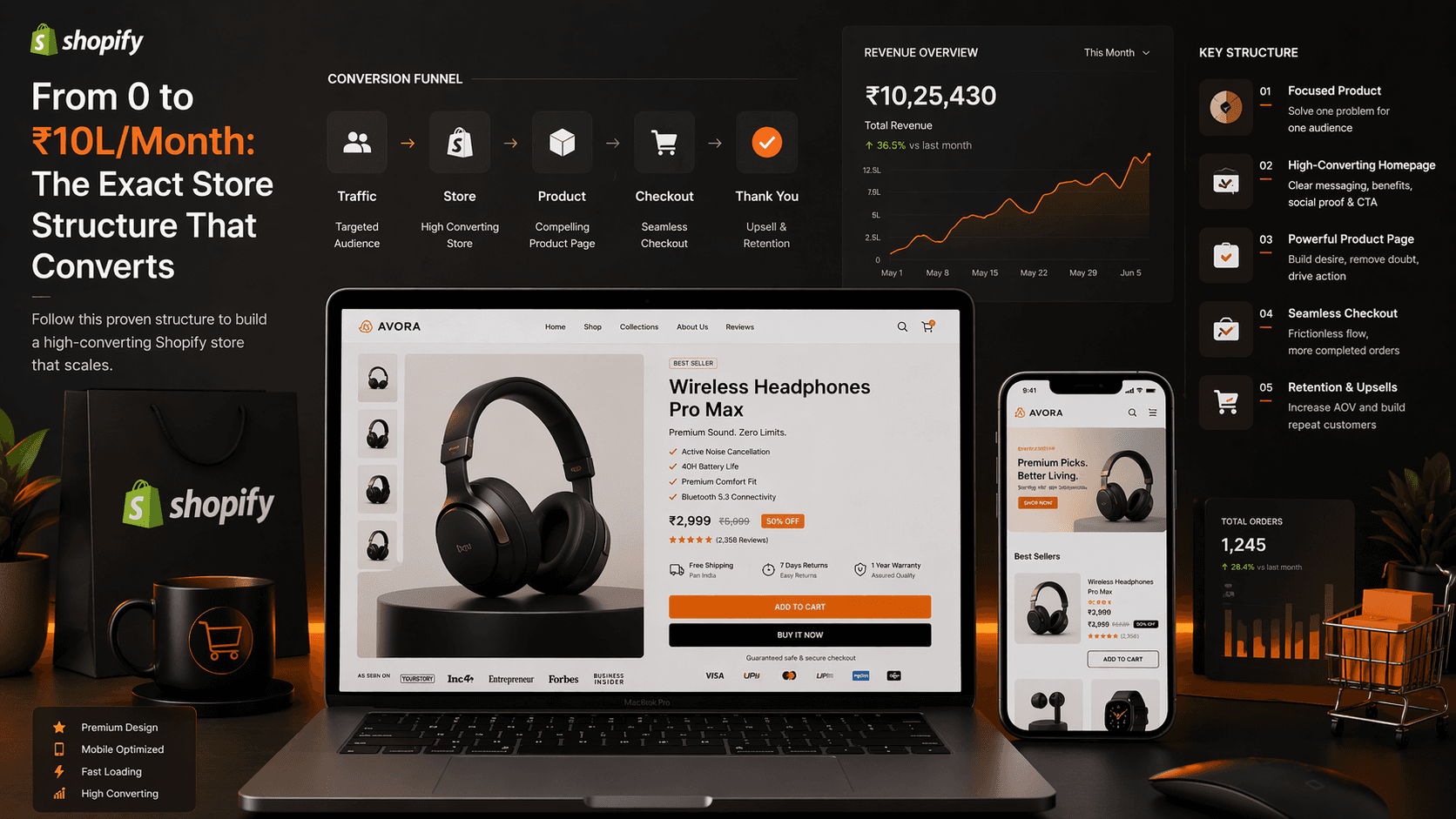
Most Shopify storThe Shopify Store Blueprint: How to Build a Store That Scales to ₹10L+ Per Month
Launching a Shopify store has never been easier. Building one that consistently generates revenue is a completely different challenge.
Thousands of new Shopify stores go live every day, yet the majority fail to achieve sustainable growth. Contrary to popular belief, the biggest problem isn’t the product itself. Most stores fail because they’re built without a clear strategy, weak product positioning, poor user experience, and no conversion-focused structure.
Many businesses spend heavily on Facebook Ads, Google Ads, and influencer marketing, only to discover that visitors aren’t buying. They blame traffic, competition, or advertising costs. In reality, the issue often lies within the store itself.
At Sterlingweb Growth Labs, we approach Shopify differently. We don’t build online catalogs—we build conversion-focused eCommerce systems engineered to attract qualified visitors, maximize conversions, and scale profitably.
Here’s the framework we use to build Shopify stores capable of generating ₹10L+ in monthly revenue.
Start With One Product, One Audience, One Goal
One of the biggest mistakes new store owners make is trying to sell everything to everyone.
A successful Shopify store begins with focus.
Instead of offering hundreds of unrelated products, identify one hero product or build around a tightly defined niche. Your product should solve one specific problem for one clearly defined audience.
Ask yourself:
- Who is my ideal customer?
- What pain point am I solving?
- Why should customers choose my product over competitors?
- What transformation does my product provide?
The more specific your positioning becomes, the easier your marketing, messaging, and advertising will be.
Focused brands consistently outperform general stores because customers immediately understand what they offer.
Turn Your Homepage Into a Sales Page
Many Shopify homepages look attractive but fail to generate sales.
Visitors don’t arrive on your website to admire the design—they arrive looking for confidence that your product can solve their problem.
Your homepage should function like a high-converting landing page.
A proven homepage structure includes:
- A compelling headline that communicates the primary benefit
- A strong value proposition above the fold
- High-quality product images or videos
- Key product benefits presented in an easy-to-scan format
- Customer testimonials and user-generated content
- Problem-to-solution storytelling
- Frequently asked questions
- Multiple strategically placed call-to-action buttons
Every section should move visitors one step closer to purchasing.
If your homepage isn’t guiding users toward checkout, it’s leaking potential revenue.
Create Product Pages That Remove Every Objection
Your product page is where buying decisions are made.
Unfortunately, most Shopify stores provide only basic descriptions copied from suppliers.
That approach rarely converts.
A high-performing product page answers every question before customers think to ask it.
Include:
- Professional lifestyle photography
- Demonstration videos
- Benefit-driven headlines
- Persuasive product descriptions
- Feature-to-benefit explanations
- Customer reviews
- Trust badges
- Shipping information
- Return policy
- Warranty details
- Frequently asked questions
- Comparison tables
- Limited-time offers
- Stock indicators
Every unanswered question creates hesitation.
Every hesitation reduces conversions.
The objective is to eliminate uncertainty and make purchasing feel like the obvious decision.
Simplify the Checkout Experience
Cart abandonment remains one of the biggest challenges in eCommerce.
One complicated checkout process can erase thousands of rupees in potential revenue.
An optimized Shopify checkout should include:
- Guest checkout options
- Minimal form fields
- Multiple payment gateways
- Fast page loading
- Transparent shipping costs
- Clear return policies
- Secure payment indicators
- Mobile-friendly payment flow
Remove unnecessary distractions.
Reduce decision fatigue.
Make purchasing effortless.
Small improvements in checkout can dramatically increase revenue without spending additional money on advertising.
Design for Mobile First
Today, the majority of Shopify traffic comes from smartphones.
Yet many stores are still designed primarily for desktop users.
A mobile-first Shopify experience includes:
- Lightning-fast loading speeds
- Sticky Add-to-Cart buttons
- Thumb-friendly navigation
- Large touch targets
- Mobile-optimized product galleries
- Easy-to-complete forms
- Simplified navigation menus
- Streamlined checkout process
Google also prioritizes mobile usability when evaluating websites.
A mobile-optimized store improves both SEO rankings and conversion rates.
Build Systems That Generate Revenue Automatically
A successful Shopify store doesn’t rely solely on first-time purchases.
The real profitability comes from automated systems running behind the scenes.
Every store should include:
Email Marketing Automation
Recover abandoned carts automatically.
Welcome new customers.
Recommend complementary products.
Request product reviews.
Encourage repeat purchases.
SMS Marketing
Recover abandoned checkouts.
Send promotional offers.
Announce product launches.
Notify customers about shipping updates.
Upsell and Cross-Sell Strategies
Increase average order value through:
- Product bundles
- Frequently bought together recommendations
- Post-purchase upsells
- Subscription offers
Increasing Average Order Value (AOV) often has a greater impact than acquiring additional traffic.
Focus on High-Intent Traffic
Traffic alone doesn’t generate revenue.
Qualified traffic does.
Many businesses chase low-cost clicks instead of buyers.
Successful Shopify marketing focuses on visitors with genuine purchase intent.
Traffic sources may include:
- Google Search
- Shopping Ads
- Meta Ads
- Email campaigns
- Organic SEO
- Influencer partnerships
- AI-powered search platforms
Your advertising, landing pages, and product messaging should remain consistent from the first click to final checkout.
Message consistency improves Quality Score, lowers advertising costs, and increases conversions.
Use Data to Continuously Improve
The highest-performing Shopify brands never stop optimizing.
Every visitor leaves valuable information.
Track:
- Conversion rates
- Heatmaps
- User journeys
- Cart abandonment
- Product page engagement
- Checkout completion
- Average Order Value
- Customer Lifetime Value
- Revenue by traffic source
- Returning customer rate
Instead of making assumptions, use data to identify exactly where customers are dropping off and improve those areas continuously.
Incremental improvements compound into significant revenue growth over time.
Optimize Store Speed for Better Rankings and Sales
Website performance has a direct impact on customer experience, SEO, and conversions.
Slow-loading Shopify stores increase bounce rates and reduce trust.
Performance optimization should include:
- Lightweight themes
- Compressed images using WebP or AVIF
- Lazy loading
- Minified CSS and JavaScript
- Reduced third-party apps
- Optimized fonts
- Efficient code
- CDN optimization
A faster website creates a smoother shopping experience and helps improve both search visibility and sales.
Build for Long-Term Scalability
Many Shopify stores become difficult to manage as they grow.
A scalable store includes:
- Clean navigation structure
- Organized collections
- Flexible product templates
- Custom Shopify sections
- Metafields for structured content
- Automated inventory management
- App integrations that support growth
- Clean, maintainable code
Scalability ensures your store can handle increased traffic, larger product catalogs, international expansion, and new marketing campaigns without sacrificing performance.
Future-Proof Your Shopify Store
Search is evolving rapidly.
Customers increasingly discover products through AI-powered platforms like ChatGPT, Gemini, Claude, and Perplexity—not just traditional search engines.
Modern Shopify stores should be optimized for:
- Technical SEO
- Structured data
- Answer Engine Optimization (AEO)
- Generative Engine Optimization (GEO)
- Core Web Vitals
- AI-friendly content
- Rich product schema
- Product review markup
- Merchant Center optimization
Preparing for AI-driven search today gives your business a competitive advantage tomorrow.
Why Businesses Choose Sterlingweb Growth Labs
At Sterlingweb Growth Labs, we build Shopify stores that combine strategy, performance, and conversion optimization.
Our Shopify services include:
- Custom Shopify Store Development
- Shopify Theme Customization
- Shopify App Development
- Conversion Rate Optimization (CRO)
- Shopify SEO
- Core Web Vitals Optimization
- Technical SEO
- AEO & GEO Optimization
- Speed Optimization
- Shopify Migrations
- Marketing Automation
- Ongoing Growth Support
We don’t measure success by how a store looks—we measure it by how it performs.
Final Thoughts
The difference between an average Shopify store and a high-performing eCommerce business isn’t the product alone—it’s the system behind it.
When strategy, positioning, user experience, performance, automation, SEO, and conversion optimization work together, your Shopify store becomes far more than an online catalog. It becomes a scalable revenue engine that attracts qualified traffic, converts visitors into customers, and supports long-term business growth.
If your store isn’t delivering consistent sales, don’t assume you need more traffic. First, evaluate how your store is built.
A well-structured Shopify store doesn’t just generate orders—it builds a sustainable, profitable business that continues to grow month after month.